
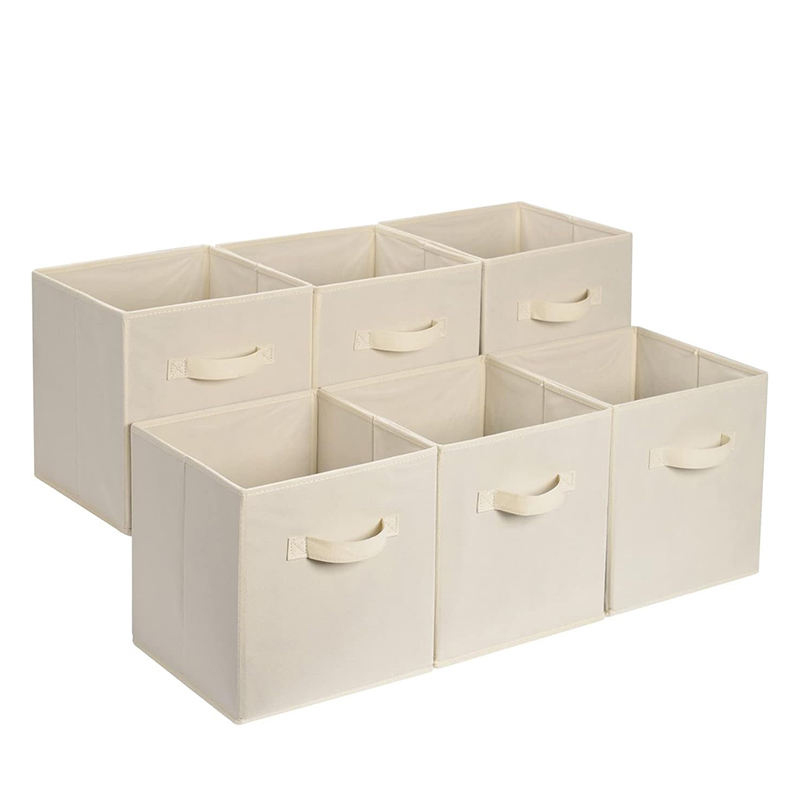
Clothing in wardrobes, miscellaneous items on shelves, and toys in children’s rooms are often not simply lacking space to store; rather, they lack suitable categorization and storage tools. The fabric cubic storage box uses a relatively organized internal structure to consolidate scattered items, making it suitable for household organization, wardrobe storage, open shelving, and everyday storage.
For consumers, selecting a storage box requires consideration of its dimensions, appearance, and ease of use; for brand owners, wholesalers, retailers, and importers, they must further assess whether the product structure meets the demands of the target market, whether the folding design is practical, and whether consistent specifications can be maintained during mass production.
Choosing the right fabric cube storage box is not merely about adding another storage container; it is also about achieving a reasonable balance between space utilization, product use, and procurement costs.
Storage Uses of Fabric Cube Bins
Wardrobes and Clothing Organization
A common problem in wardrobes is that clothing is not properly categorized; socks, scarves, underwear, and seasonal accessories tend to end up mixed together. Cube storage boxes allow items of different categories to be stored separately, reducing the need to search through the closet and making it easier to arrange items according to how often they are used.
If used for a wardrobe compartment, first measure the compartment’s internal width, depth, and height, then determine the external dimensions of the storage box. The box should not be too wide; otherwise, it may be difficult to remove once the item has been placed inside. If its height exceeds the compartment’s usable space, normal use will also be affected.
For products primarily used to store lightweight clothing, priority should be given to the fabric, the shape of the storage compartment, and the ease of daily access. If the storage box is frequently accessed, particular attention should be paid to the placement of the handles and whether the side walls of the compartment are prone to deformation.
Open shelving
A cubic structure is particularly well suited for categorizing and organizing items on open storage racks. Multiple storage boxes can be grouped by item category or by area of use, reducing the direct exposure of scattered items.
This type of application is relatively sensitive to dimensional consistency. When purchasing multiple storage boxes for the same set of shelving units, it is advisable to standardize the specifications as much as possible and verify the actual external dimensions of the products after they are unfolded. Even if the products have identical nominal dimensions, factors such as fabric thickness, support structure, and sewing method may still affect the final space they occupy.
If you plan to stack storage boxes vertically, you should also verify whether the product is suitable for this type of use. Fabric storage boxes do not necessarily possess the load-bearing capacity and stability of rigid storage units; therefore, you should not assume that they can be stacked for extended periods simply because they have a neat appearance.
Storage for Toys and Daily Miscellaneous Items
Toys, craft supplies, electronic accessories, and other household items typically vary in size and are frequently taken out and put back. Using cubic storage boxes for categorization can reduce clutter and make cleaning and reorganizing more convenient.
When procuring, consider whether the box opening facilitates the insertion and removal of items, and whether the box can maintain its basic shape after being loaded with items. For items that are large or have sharp edges, it is also necessary to check whether the internal space is adequate, so as to avoid compromising the fabric and stitching due to an unsuitable load.
Prioritize Size Over Capacity
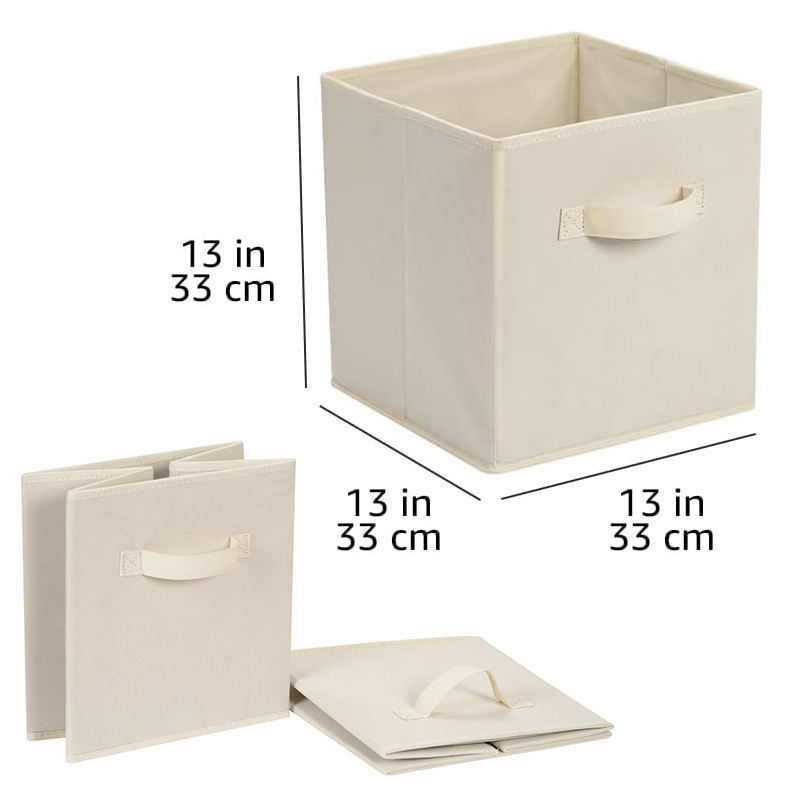
Fabric cube storage boxes generally have a relatively regular shape, but this does not mean that any cube size is suitable for all spaces. If the size is chosen incorrectly, even if the product itself has no issues, it may still fail to fit into the intended location or waste space after being placed there.
Before selecting a model, you should first confirm three aspects: the actual dimensions of the placement location, the dimensions of the primary items to be stored, and the space that needs to be reserved when retrieving or placing items.
If the product is intended for use in a wardrobe or shelving unit with fixed dimensions, measure the available internal width, depth, and height rather than relying directly on the furniture’s nominal dimensions. If it is intended for storing taller items, also verify whether the cabinet height and opening are convenient for operation.
At the same time, it is necessary to distinguish between a product’s external dimensions and its internal usable space. Fabric thickness, hemming, stitching, and internal support structures all occupy a certain amount of space; therefore, the actual load capacity cannot be simply calculated from the product’s external length, width, and height.
For bulk procurement, it is recommended that the measurement method for the product’s length, width, and height be clearly specified in the specification sheet, along with agreed tolerances for dimensional variation. This not only facilitates comparisons among different suppliers but also streamlines subsequent sample verification and mass-production acceptance.
The cabinet structure determines the storage experience
Fabric and support structure should be matched to the intended use
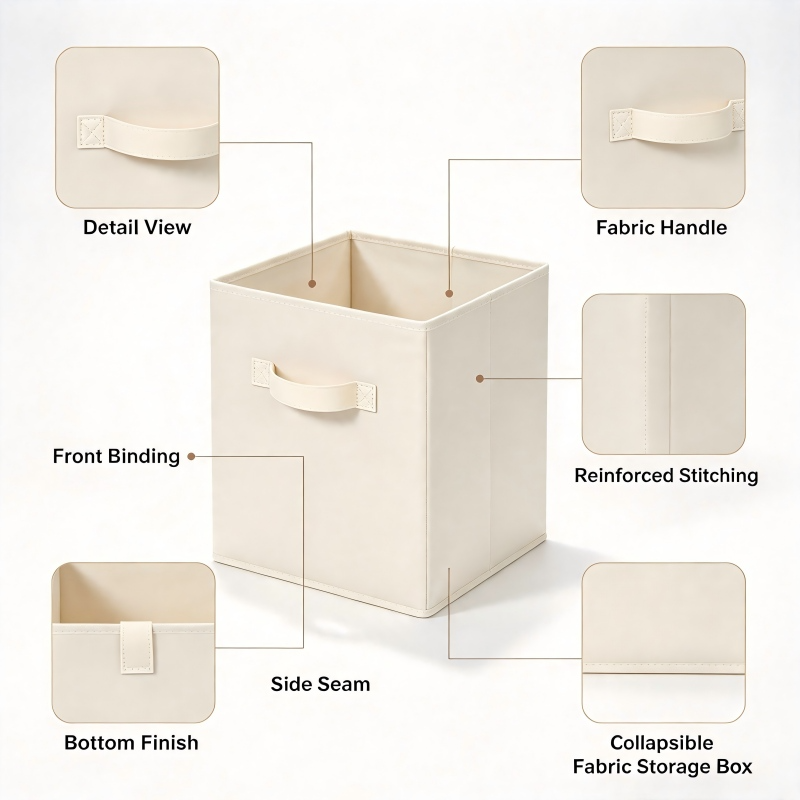
The appearance and performance of a fabric cubic storage box depend not only on the fabric used but also on the structure of the base, side walls, and joints.
If the product is primarily intended for storing lightweight clothing, priority should be given to the fabric’s feel, appearance, folding convenience, and cleaning and maintenance requirements. If it is used for toys, a variety of miscellaneous items, or objects that need to be moved frequently, further attention should be paid to the base support, the shape of the side walls, and the placement of the handle attachment.
The purchaser should not determine whether a product is durable solely based on the fabric name or its thickness. Different materials and structures exhibit varying actual performance; therefore, suitability should be assessed in conjunction with the intended load, frequency of use, and sample performance.
If the product needs to maintain a neat, cubic shape, it should be verified whether the support structure is easy to install or deploy, and whether issues such as side-wall collapse or bottom deformation are likely to occur during routine use.
Handle design affects ease of handling
A handle is one of the key features of a fabric storage box with a handle. It enables users to pull the box out from a shelf or wardrobe and makes it easier to move stored items when organizing the space.
When selecting a product, check the position and length of the handle, the stitching method, and whether the handle is likely to come into contact with the edge of the case or interfere with hand operation when lifting it. For products that need to be moved frequently, the connection between the handle and the case should receive particular attention.
If the planned storage of purchased products involves relatively heavy items, the performance of the handles and connection points should be evaluated through actual loading and lifting tests. The mere fact that a product is equipped with a handle does not mean that it is automatically suitable for supporting any weight.
For custom-branded storage boxes, the color, width, and appearance of the handles may also be incorporated into the design requirements; however, aesthetic adjustments should not replace verification of the structure and intended practical use.
The folding mechanism should balance storage and deployment
A foldable design can help reduce the space occupied when the product is not in use, offering value for retail inventory, warehousing, and transportation. However, whether the folding feature is practical depends on the product’s overall structure.
During procurement, it should be verified whether the folding process is simple, whether the folded product is easy to organize and package, and whether it can be restored to its intended shape after being unfolded again. If the product requires a base plate or other support components, the configuration method for these components and the corresponding packaging requirements should also be clearly specified.
For retail products, consumers typically expect the package to be unfolded and put into use relatively quickly after unboxing; for bulk purchasers, however, they need to consider the folded dimensions of individual items, the capacity of the outer carton, and available transport space.
Therefore, the folding feature should not merely serve as a selling point in the product description; it should also be verified through practical operation during the sample stage.
Evaluating Product Configurations
Demand for fabric cube storage boxes varies across different sales channels. Buyers should first identify their primary target customers and usage scenarios, and then determine which configurations should be retained.
For products targeting the everyday home organization market, priority should be given to color, fabric appearance, handle convenience, and folding design. For retail channels that place emphasis on shelf organization, attention should be paid to uniform dimensions, consistent appearance, and the overall look when multiple storage units are arranged together.
If the product is intended for use in children’s rooms or in areas of high-frequency use, the materials, edge treatment, and structural performance should be evaluated in light of the intended mode of use. If the target market has explicit requirements regarding label, packaging, or material compliance, these requirements should also be specified during the development stage to avoid making last-minute adjustments after the samples have been completed.
For customized projects, the following items may be discussed based on actual requirements:
- Dimensions and specifications: Determine based on the target furniture, items to be stored, and available space
- Fabric and color: Select based on product positioning, intended use, and aesthetic requirements
- Structural configuration: Determine whether bottom support, side-wall support, and other structural components are required
- Handle design: Confirm position, dimensions, color, and connection method
- Brand and packaging: Determine the requirements for logos, labels, individual-item packaging, and outer cartons based on the sales channels.
Not all projects require the addition of complex configurations. A sound procurement strategy should first prioritize meeting core usage requirements, and then assess whether additional features provide any practical value.
How B2B Procurement Can Minimize Discrepancies Between Samples and Mass Production
For brand owners, wholesalers, retailers, and importers, sample verification is an indispensable step in the product development process. Product images can help assess the appearance, but they cannot fully convey dimensions, form finish, lift performance, or folding behavior.
Before confirming the sample, the purchaser should provide the storage-box supplier with clear requirements, including the intended use case, expected dimensions, primary items to be stored, material preferences, quantity, and packaging requirements. The clearer the requirements, the easier it is to minimize repeated revisions.
Once the sample has arrived, verification can be carried out from the following aspects.
First, verify whether the external dimensions match the specified dimensions and check whether the cabinet can assume the intended shape when unfolded. Next, place the items intended for storage inside and observe whether the interior space is sufficient, whether items can be easily accessed and stored, and whether any significant deformation has occurred at the bottom or along the side walls.
Next, inspect the handle connection points, main seams, and edge finishing, and conduct a lifting and handling test in accordance with the product’s intended use. If the product’s primary feature is folding, it should also be folded and unfolded in practice; the operating method and the resulting shape should then be verified to ensure they meet the required specifications.
Finally, confirm the product color, labeling location, packaging method, and dimensions after folding. If the product requires containerized transportation, also verify whether the unit packaging and outer carton configuration comply with warehousing and logistics requirements.
Once the sample has passed validation, it is recommended that the validated sample and the written specifications together serve as the basis for mass production. When there are changes to materials, structure, dimensions, or key components, the impact on product performance should be re-evaluated; the validation results obtained for the original sample should not be assumed to remain applicable.
Look Beyond Unit Price
The quotation for fabric cube storage boxes may be influenced by factors such as dimensions, materials, support structure, handle configuration, printing method, order quantity, and packaging requirements.
If products supplied by different vendors have differing configurations, a direct comparison of unit prices can easily lead to erroneous conclusions. For example, one product may employ a different bottom-support design, while another may differ in its fabric, handle, or packaging. Only after standardizing procurement specifications can price comparisons provide more meaningful reference value.
When conducting procurement inquiries, the product dimensions, material requirements, color, structure, order quantity, brand identification, and packaging method should be specified as clearly as possible; suppliers should also be required to submit quotations based on the same set of specifications.
For foldable products, it is also possible to further assess the folded packaging volume and the capacity of the outer carton. However, when evaluating transportation costs, one should not focus solely on whether the packaging is compact; it is also necessary to confirm that the product can function properly once unfolded.
If you plan to procure the same product over the long term, you should also pay attention to the supplier’s ability to cooperate with specification confirmation, sample modifications, mass-production follow-up, and quality inspections. Stable product specifications help reduce communication costs associated with repeated development and subsequent product inspections.
Frequently Asked Questions
Is a fabric cube storage box suitable for placing in a wardrobe?
It is suitable, but you should first measure the actual width, depth, and height of the wardrobe compartment, and ensure that the unit can still be easily removed after being placed inside.
Can a foldable fabric storage box hold heavy items?
Assessment should be based on the fabric, base support, stitching, and handle construction. Before procurement, sample testing should be conducted in conjunction with the expected load capacity; it is not advisable to judge load-bearing capacity based solely on visual appearance.
What information needs to be provided before bulk procurement?
It is recommended that the target dimensions, intended use, primary items to be stored, material preferences, order quantity, brand logo, and packaging requirements be provided, so that the supplier can accurately evaluate the proposed product solution.
Can Specs Change After Sample Approval?
Modifications may be discussed; however, changes to dimensions, materials, or structure may affect product performance. When critical specifications are involved, the sample should be reconfirmed, and the written production requirements should be updated.
Smarter Storage, Better Procurement
When selecting a fabric cube storage box, you should start from the actual storage scenario and sequentially determine the dimensions, materials, box structure, handles, and folding method; then verify its performance through a sample. For bulk procurement projects, clear specification documents, a rational packaging solution, and consistent mass-production standards are more important than simply pursuing aesthetics or the lowest price.
Only when product design aligns with actual needs can fabric cubic storage boxes deliver their intended value in daily organization, retail display, and bulk supply.