
The frosted PVC travel toiletry bag is not only a daily storage item, but also a customizable product category for travel retailers, gift brands, and importers looking to develop travel accessory lines.
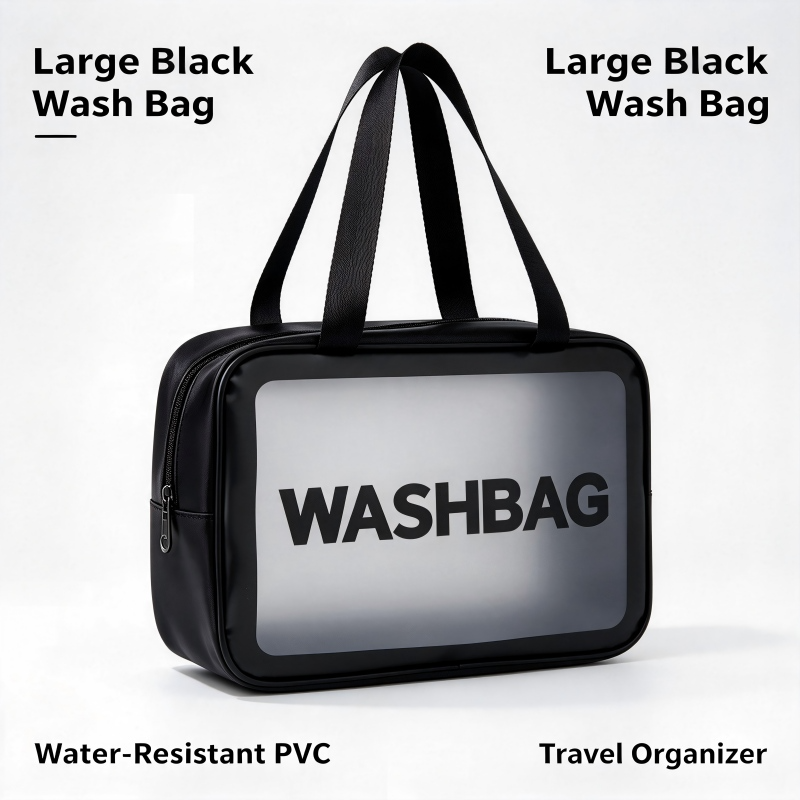
Compared with conventional fabric toiletry bags, frosted PVC toiletry bags feature easy-to-clean surfaces, waterproof materials, and a sleek appearance. Crafted from frosted PVC with a translucent front panel, this product strikes a balance between offering visual display and allowing users to quickly identify internal items. The spacious interior accommodates full-sized cosmetics, toiletries, and personal care items, while the woven handles provide convenient portability for daily use.
For B2B buyers, developing a personalized PVC travel toiletry bag involves more than just defining the appearance and logo—it also requires careful consideration of PVC material specifications, bag dimensions, zipper configurations, handle attachment methods, and mass-production consistency. Finalizing these details in the sample and product specifications early on helps minimize subsequent production adjustments.
Use Cases Determine Product Positioning
Before developing a frosted PVC travel toiletry bag, it is essential to identify the target consumer group and primary use cases.
- For travel retail, the product must balance storage capacity, portability, and daily cleaning convenience. A spacious body accommodates toiletries of various specifications, while the translucent front panel helps users quickly view internal contents.
- For hotel amenities or gift sets, greater emphasis should be placed on overall appearance, logo display, and packaging presentation. The product must not only meet basic storage needs but also align with the brand image and the contents of the set.
- For cosmetics brands and personal care suppliers, PVC toiletry bags serve as matching storage accessories. In this case, bag dimensions and opening sizes must be determined based on the product dimensions within the set to avoid insufficient internal capacity or difficulty closing the bag after loading.
Different application scenarios impose varying product requirements. Therefore, buyers should first clarify their target market, expected contents, and sales positioning before discussing material and structural configurations with the manufacturer.
Frosted PVC Material and Surface Effects
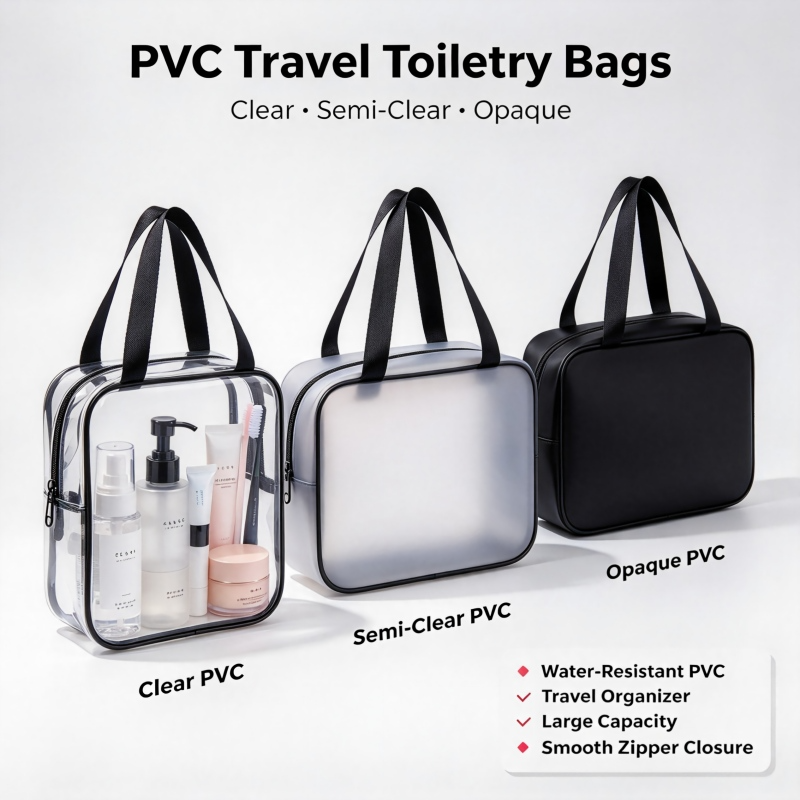
PVC is one of the most common materials for travel toiletry bags. Compared with regular transparent PVC, frosted PVC offers a different surface visual effect.
The frosted surface presents a soft, translucent texture that reduces the fully exposed look of internal items while maintaining a degree of visibility. For travel goods that prioritize a clean aesthetic and practicality, this design accommodates both product display and daily use.
However, different PVC materials may vary in thickness, softness, surface texture, and color. If the material is too thin, it may compromise the overall structural support and user experience; if it is too thick, it can increase product weight, material costs, and processing difficulty.
Consequently, buyers should not judge product quality solely by the name “PVC.” Before sampling, confirm the material thickness, frosted effect, color, and surface condition with the toiletry bag manufacturer, and check whether the material is prone to obvious creases, whitening, or other appearance changes after bending.
For bulk procurement projects, the confirmed PVC material specifications and samples should serve as the benchmark for mass production to prevent noticeable batch-to-batch variations in thickness, color, or surface effects.
Translucent Front Panel and Brand Display
An important design feature of the frosted PVC travel toiletry bag is its translucent front panel.
Compared with fully transparent bags, the translucent design reduces the direct exposure of internal contents while giving users a general overview of what is stored inside. This structure is well-suited for organizing travel toiletries, cosmetics, and personal care items.
From a brand development perspective, the front panel is also a key visual area to consider. If a logo is required, the printing position, size, and color can be determined based on the brand design to ensure a strong visual contrast between the brand identifier and the frosted surface.
It is important to note that PVC surface effects influence print rendering. Different colors and printing techniques can yield varying visual results, so relying solely on digital mockups to confirm the final appearance is not recommended.
During the sampling stage, check whether the logo position is accurate, pattern edges are sharp, colors meet brand requirements, and the printed area preserves the original translucency of the front panel. For projects with strict visual brand standards, providing official logo files and color references is recommended for accurate sample confirmation.
Bag Dimensions and Actual Storage Space
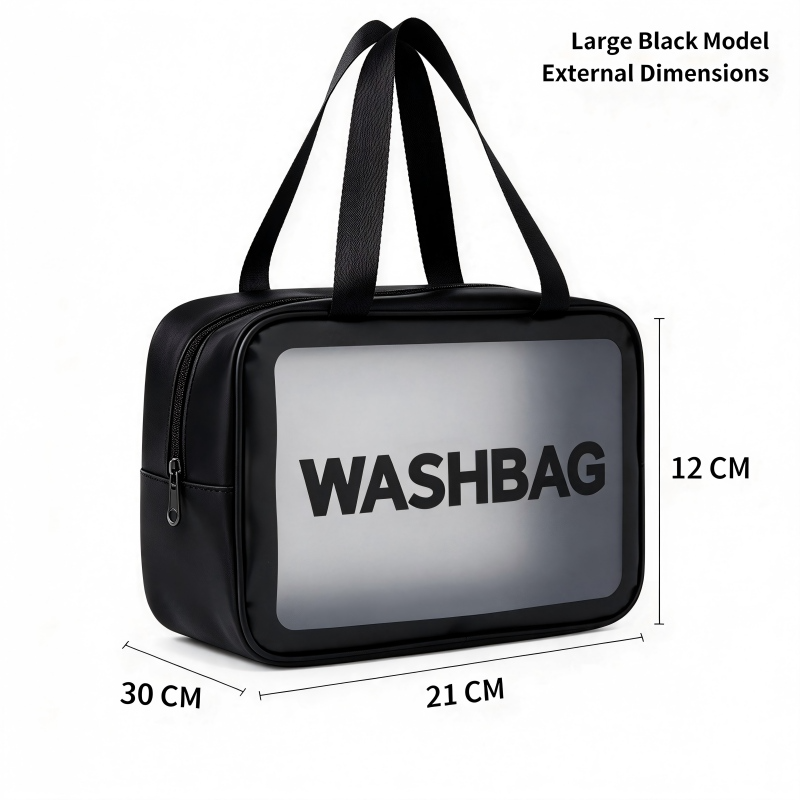
The dimensions of a travel toiletry bag should not be judged solely by its external length, width, and height; the internal usable space and zipper opening must also be taken into account.
This frosted PVC travel toiletry bag is primarily designed to hold full-sized cosmetics, toiletries, and personal care items. Therefore, when determining bag dimensions, first outline the specifications and quantities of the target items, then assess whether the product requires extra width, height, or bottom gusset space.
For example, taller bottles require sufficient bag height, while packing multiple cosmetics simultaneously calls for careful internal spatial distribution and ease of access. If the bag is large but the zipper opening is inadequate, users may still struggle to insert or retrieve items smoothly.
For customized travel toiletry bags, buyers are advised to provide the length, width, height, and estimated quantity of the primary items to be stored. Manufacturers can use this information to evaluate bag dimensions and structure, and conduct actual loading tests during the sampling phase.
Confirmation checks should cover internal available space, item arrangement, zipper closure condition, and whether the bag deforms significantly after loading. If the product has strict dimensional consistency requirements, the specification document should explicitly define measurement locations, methods, and allowable tolerances.
Zipper Configuration and Bag Connection Craftsmanship
The zipper is a vital component of a PVC travel toiletry bag, directly impacting the opening/closing experience and daily usage.
For such toiletry bags, the zipper must match the bag dimensions, opening structure, and material characteristics. A zipper that is too short can hinder item retrieval, while uneven attachment between the zipper and the bag body can affect appearance and smooth operation.
Due to the distinct processing traits of PVC compared to regular fabrics, manufacturers must determine suitable connection techniques based on the specific materials and product structure, focusing inspection on both ends of the zipper, connection zones, and bag edges.
Prior to mass production, repeated opening and closing tests on samples are recommended. Afterward, inspect whether the zipper runs smoothly, the puller and teeth function normally, the ends are secure, and whether the connection areas show loose threads, deformation, or other obvious defects.
For projects with explicit durability requirements, buyers can pre-agree on test cycles and acceptance criteria, incorporating test results into the sample confirmation record.
Woven Handles and Carrying Structure
This frosted PVC travel toiletry bag features a woven handle design, making it convenient for users to carry independently during travel, hotel stays, or daily routines.
Although the handle is an auxiliary structure, its attachment method directly impacts the practical user experience. Especially when the toiletry bag is loaded with multiple personal care items, the connection zone between the handle and the bag must withstand corresponding tensile forces.
Therefore, focus should extend beyond the appearance and length of the handle to verify whether the handle material, attachment position, and anchoring craftsmanship suit the intended application.
During the sample confirmation stage, it is advisable to load actual toiletries or an agreed-upon equivalent load before performing lift and short-term carrying checks. Closely observe whether the handle connection shows loosening, loose threads, tearing, or noticeable deformation while keeping the bag in its normal shape.
If uneven stress or structural anomalies are found during testing, the connection method should be adjusted promptly, and modified samples re-verified. Specific loads and test conditions should be mutually determined by the buyer and manufacturer based on the target application.
Customization Options for Personalized PVC Toiletry Bags
For travel goods brands, gift suppliers, and retailers, personalized customization is a crucial step in PVC toiletry bag development.
Common customization elements include logos, colors, material surface finishes, and packaging design. Buyers can establish the overall product style according to their visual brand system, enhancing brand recognition through logo printing, handle color-matching, or other exterior details.
However, more customization elements can increase the complexity of product development and manufacturing processes. For instance, adding special printing effects requires verifying the compatibility between the material surface and the printing technique, while adjusting material colors requires confirming consistency between actual PVC samples and brand color standards.
It is recommended to finalize the following information before sampling:
- Bag dimensions, structure, and material specifications
- Frosted PVC color and surface effects
- Translucent front panel design requirements
- Woven handle and zipper configurations
- Logo files, positions, sizes, and printing effects
-
Product packaging methods and bulk order quantities
This information should be compiled into written specifications after sample approval to prevent discrepancies caused by differing interpretations during subsequent mass production.
Waterproof Performance and Quality Inspection of PVC Toiletry Bags
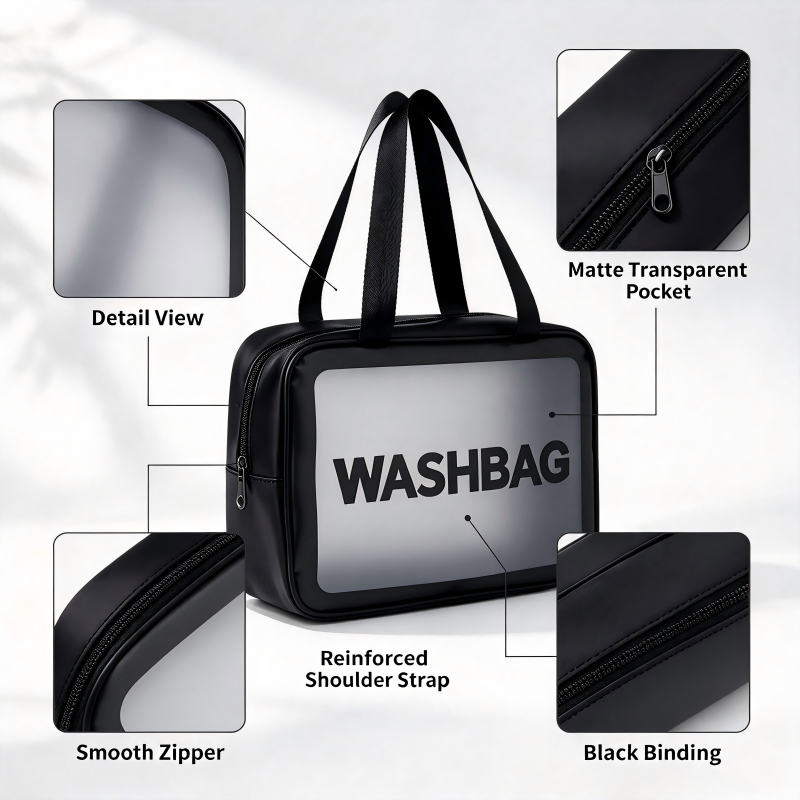
PVC materials possess inherent waterproof properties and are relatively easy to clean, making them suitable for travel toiletry storage scenarios where exposure to moisture may occur.
However, a distinction must be made between material waterproofing and finished-product waterproofing. The PVC body being waterproof does not automatically mean that zippers, connection points, and other processed areas can completely prevent water ingress.
If the product is mainly for daily organization, focus can center on surface cleanability and general water-splash resistance. If the procurement project has explicit anti-seepage requirements, testing methods, test conditions, and acceptance criteria must be agreed upon in advance and verified using complete finished products.
During mass production, key inspection points should include the PVC material surface, bag dimensions, zipper operation, handle attachment, and logo printing quality. For frosted PVC, pay attention to whether there are obvious scratches, stains, creases, or appearance deviations from the approved sample.
Quality inspection standards should be based on mutually confirmed samples and written specifications, rather than relying solely on visual inspection to judge compliance.
Cost and Quotation for Custom PVC Travel Toiletry Bags
For B2B procurement, the final price of a PVC travel toiletry bag is typically influenced by factors such as materials, structure, customized craftsmanship, and order quantity.
- First is material cost. Variations in PVC thickness, specifications, colors, and surface effects can result in different material costs.
- Second is product structure. A basic zippered pouch has a relatively simple structure, whereas adding special panel stitching, internal pockets, or other features may increase material consumption and processing steps.
- Third is customization. Logo printing, special colors, zipper configurations, and personalized packaging all require calculation based on actual craftsmanship.
When requesting a quotation, buyers are advised to simultaneously provide product dimensions, material requirements, logo designs, estimated quantities, and packaging needs. If reference samples or design drawings are already available, they should be provided together to help manufacturers evaluate production feasibility.
When comparing quotes from different suppliers, verify whether material specifications, product structures, custom techniques, packaging methods, minimum order quantities (MOQs), and lead times are consistent. Any sample fees, plate-making fees, or other customization costs should also be confirmed beforehand to avoid judging procurement costs solely by unit price.
From Sample Confirmation to Stable Mass Production
For customized PVC travel toiletry bags, sample confirmation serves as the critical bridge connecting product development and mass production.
Buyers should place actual toiletries into the sample to check internal space, item retrieval, and zipper closure; followed by checking the frosted PVC surface effect, translucent front panel, woven handles, and overall appearance.
If custom logos are required, verify the printing position, size, color, and clarity. For projects with explicit waterproof requirements, conduct finished-product verification in accordance with pre-agreed testing standards.
If issues arise with the sample, record specific locations and adjustment requirements for the manufacturer to modify and re-confirm. Once approved, retain the confirmation sample along with written specifications detailing materials, dimensions, colors, structures, accessories, printing, and packaging requirements as the benchmark for mass production and subsequent quality inspections.
For repeat orders, continuously check material and appearance consistency across different batches. If materials, structures, or custom processes change, communicate in advance and obtain buyer confirmation.
Translating Product Design into Successful Mass Production
A high-quality frosted PVC travel toiletry bag requires not only a sleek appearance and practical storage space, but also reasonable material configurations, stable zipper structures, and reliable handle connections.
For brands, travel goods retailers, and importers, product development should stem from actual usage needs, translating materials, dimensions, sizes, custom effects, and quality requirements into samples and written specifications.
From product design to bulk delivery, every detail must be verified so that customized PVC travel toiletry bags can better meet market demands.
Frequently Asked Questions
Are frosted PVC travel toiletry bags suitable for travel?
Yes. PVC surfaces are easy to clean and possess certain waterproof characteristics, making them ideal for storing toiletries and personal care items. Specific capacity and structure should be determined based on actual loaded items.
What is the difference between frosted PVC and transparent PVC?
Frosted PVC offers a soft, translucent visual effect that reduces the full exposure of internal items while maintaining a degree of visibility; transparent PVC provides a clearer view of contents inside the bag.
Can logos be customized on PVC travel toiletry bags?
Yes, logos can be customized based on product design and material processing conditions. Printing position, size, color, and actual rendering effects should be confirmed during the sampling stage.
What structural factors should be considered for large-capacity PVC toiletry bags?
Key focus areas include bag dimensions, bottom space, and the zipper opening, ensuring full-sized toiletries can be smoothly inserted, retrieved, and zipped shut.
Are PVC toiletry bags completely waterproof?
Do not assume an entire product is fully waterproof based solely on the PVC material. Zippers, connection zones, and processed seams can affect finished-product waterproof performance; finished-product testing should be conducted when strict requirements apply.