
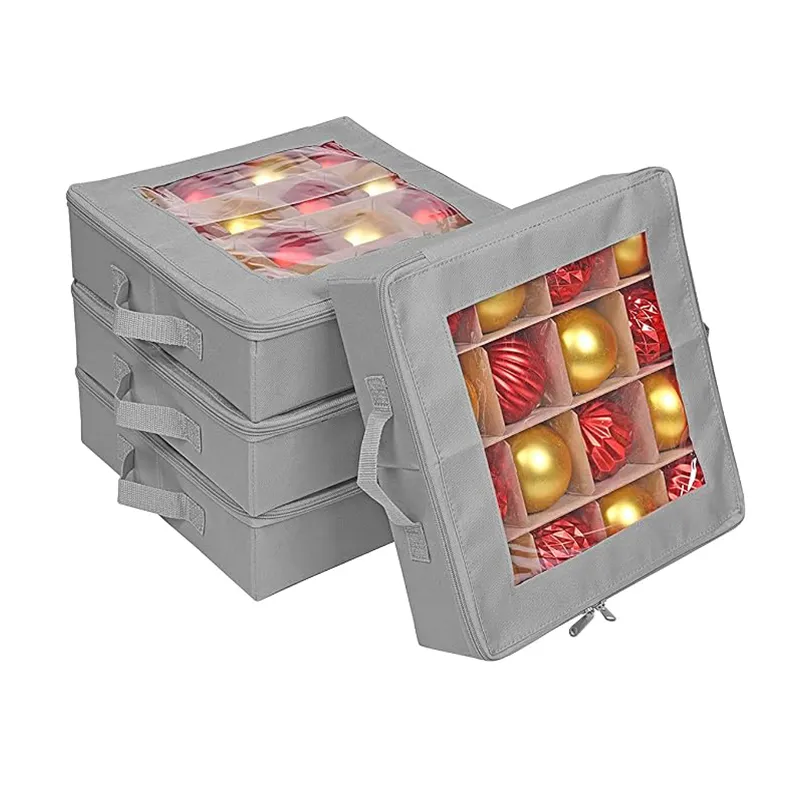
A Christmas ornament storage box with dividers needs to do more than just provide ample storage space; it must also help users categorize and protect different types of festive ornaments. Christmas baubles, hanging pendants, and string lights vary in size, shape, and fragility. If stored together without separation, they are prone to collisions during handling and long-term storage, which also increases the difficulty of retrieving them.
This Christmas ornament storage box is crafted from premium oxford fabric, featuring a sturdy cardboard lining and removable divider trays inside, capable of holding up to 64 three-inch ornaments. Additionally, the product features a transparent top window, a zippered closure structure, and dual-layer reinforced side handles. Its stackable design makes it convenient for both household and retail storage scenarios.
For brands, retailers, importers, and wholesalers, sourcing a divided Christmas ornament storage box requires looking beyond capacity and appearance. Buyers should evaluate the internal space, divider structure, box support, handle attachment, and stacking stability, and translate these key requirements into sample and production specifications.
Product Structure and Storage Design
First, Clarify Ornament Types and Actual Capacity
Different Christmas ornaments vary in size and shape. Baubles are typically suited for storage in individual compartments, whereas small pendants and figurines with protruding parts require appropriately reserved space.
While this divided Christmas ornament storage box can hold up to 64 three-inch ornaments, the actual capacity will be affected by the shape, size, and additional protective packaging of the items; not all ornaments can fit in the exact same quantity.
For B2B procurement projects, it is recommended to compile the diameter, maximum outer dimensions, quantity, and fragility of the target ornaments in advance, and conduct loading tests using representative samples to avoid judging applicability solely based on the nominal capacity.
Removable Divider Trays Offer Greater Spatial Flexibility
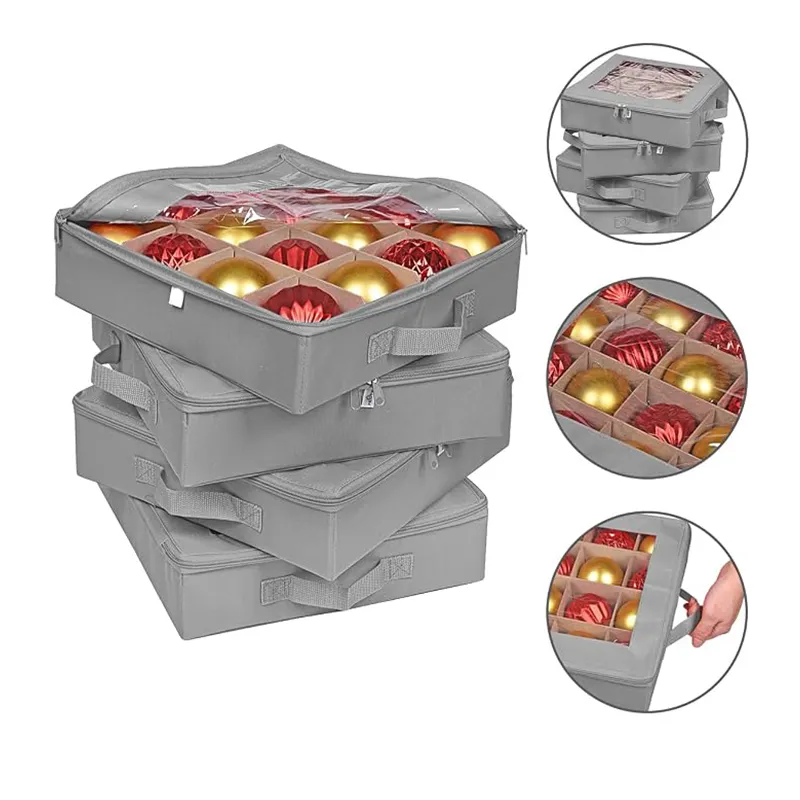
The removable divider trays are a crucial structural feature of this Christmas ornament storage box, dividing the interior into independent sections to minimize contact and collisions between ornaments.
Compared to fixed dividers, the removable structure allows the internal layout to be adjusted according to storage needs. For example, when storing standard 3-inch baubles, the compartment structure can be utilized; when storing larger ornaments, some dividers can be removed based on actual design requirements.
More dividers do not necessarily mean better performance. An increased quantity reduces individual cell space; therefore, the design should focus on grid dimensions, divider thickness, and connection stability to ensure ornaments are easy to access while preventing dividers from shifting during handling.
For customized projects, the ornament storage box manufacturer can adjust the divider layout according to the size and quantity of the target ornaments, and verify the assembly/disassembly effect and actual loading space during the prototyping stage.
Internal Dimensions vs. Capacity: Don’t Rely Solely on External Specifications
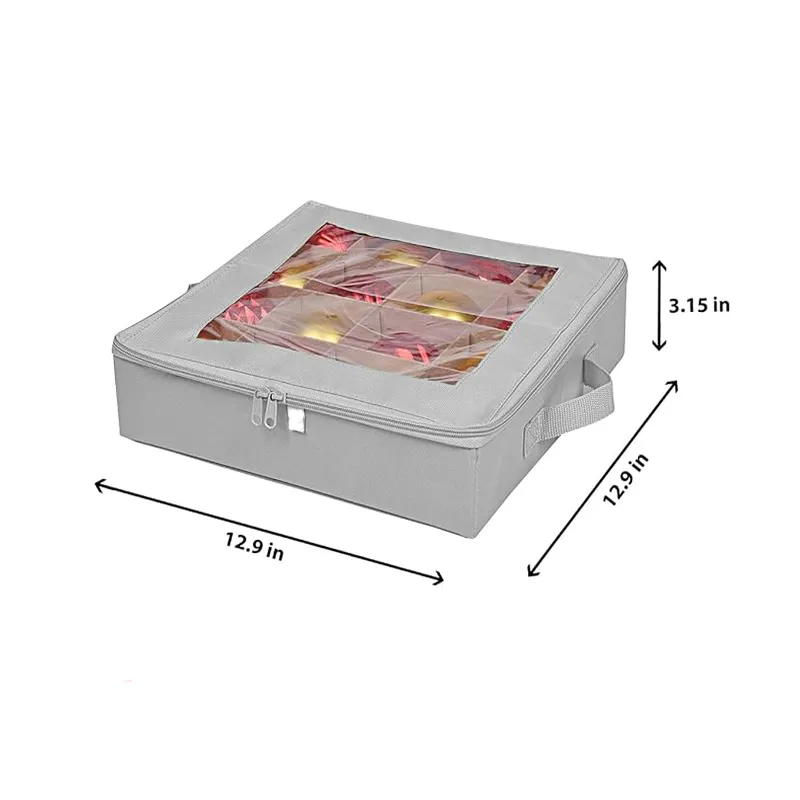
External dimensions should only serve as a preliminary reference. The true determinant of a Christmas ornament storage box’s suitability is its internal usable space.
Oxford fabric, cardboard lining, seams, and dividers all consume a certain amount of space. Therefore, buyers should simultaneously confirm the external length, width, and height, the internal usable dimensions, the opening dimensions, and the per-cell space after the dividers are installed.
For 3-inch baubles, it must be ensured that the ornaments can be smoothly placed in and taken out, while preventing cells from being too large, which would cause excessive shifting during handling. If extra cushioning packaging is required, its thickness must also be factored into the dimensional assessment.
It is recommended to confirm available space and loading quantities under different divider layouts through actual loading tests.
Oxford Fabric and Cardboard Lining: Box Support is Equally Vital
This Christmas ornament storage box uses premium oxford fabric and is equipped with a sturdy cardboard lining. The oxford fabric provides the durability required for daily use, while the cardboard lining helps the box maintain its shape, minimizing noticeable sagging after being loaded.
For B2B buyers, material quality should not be judged solely by names like “oxford fabric” or “heavy-duty”; fabric specifications, weight, color, as well as cardboard thickness and installation methods must also be confirmed.
The sample stage should focus on inspecting the support performance of the box walls, bottom, and corners to see if the cardboard lining shows obvious bending, shifting, or damage, ensuring the material structure matches the intended loading requirements.
Transparent Top Window Enhances Item Recognition Efficiency
The transparent top window helps users quickly view the ornaments inside the box, reducing the need to repeatedly open it—ideal for home attics, closets, and retail storage scenarios.
During the B2B customization process, aside from confirming whether the window is clear, attention should be paid to its size, placement, and fastening method. During sample confirmation, ornaments of various colors and types can be placed inside to check recognition effectiveness from a normal viewing angle, and to observe whether the window edges are neatly stitched and securely connected.
If the product targets the brand retail market, the layout of the transparent window can also be coordinated with logos, labels, and packaging designs to align with brand visuals.
Zipper Closure and Dust Protection
Christmas ornaments generally require long-term storage, making the closure structure an important factor in user experience.
This product adopts a zippered closure design, which helps reduce dust, dirt, and insects entering the box. However, a zipper structure does not mean the product is completely airtight or waterproof; buyers should clarify protection requirements based on target market needs.
During sample testing, the zipper should be opened and closed repeatedly to check for smooth operation, fabric snagging, and the security of the ends and corners. After loading actual ornaments, it must also be confirmed that the box opening is not overly taut, so as not to affect smooth closure.
Dual-Layer Reinforced Side Handles Ensure Handling Safety
When loaded with numerous ornaments, the overall weight of the storage box increases, making the handle attachment structure critically important.
This product features dual-layer reinforced stitched side handles for easy lifting and carrying by users. During manufacturing, handle length, installation position, stitching range, and connection method all influence practical performance.
When buyers confirm samples, they should load representative ornaments and conduct lifting, short-distance carrying, and lowering tests, focusing on whether deformation, fraying, or loosening occurs at the handle attachment points, side walls, and bottom. Specific loading weights and test conditions should be determined through consultation based on product specifications.
Stackable Structure Minimizes Storage Space Consumption
Christmas ornaments are highly seasonal, requiring efficient space utilization during long-term storage. This product adopts a stackable design, making it suitable for concentrated storage in attics, closets, and garages, and convenient for retailers to plan storage space.
However, stackable does not mean limitless stacking. Box support capacity, load weight, and stacking stability all affect practical performance.
During B2B procurement, stacking requirements (for empty or loaded boxes), expected stacking layers, and storage environments should be explicitly defined. Sample tests should check whether the bottom sags, the side walls deform, or the upper and lower boxes slide easily against each other.
B2B Procurement and Mass Production Quality Control
Clarify Product Specifications and Customization Requirements
For brands, importers, and wholesalers, customizing a divided Christmas ornament storage box involves more than just adjusting sizes or adding a logo; it requires translating capacity, materials, internal structure, and usage requirements into clear production specifications.
In the early stages of project development, the purchasing party should provide the dimensions, quantities, and types of target ornaments, and then confirm box dimensions, divider layouts, and material requirements with the manufacturer.
| Project Confirmation | Procurement Focus |
|---|---|
| Box Dimensions | External dimensions, internal usable space, and opening dimensions |
| Storage Capacity | Meeting the target requirement of 64 three-inch ornaments |
| Divider Structure | Size, quantity, assembly/disassembly method, and stability of divider trays |
| Fabric and Lining | Oxford fabric specifications, cardboard thickness, and color requirements |
| Transparent Window | Size, position, transparency, and fastening method |
| Zipper and Handles | Opening/closing performance, handle reinforcement, and connection positions |
| Stacking Requirements | Loaded state, stacking layers, and stability |
| Packaging Method | Individual packaging, outer carton dimensions, and packing quantity |
If custom colors, brand logos, labels, or packaging are required, they should be confirmed simultaneously during the sample stage. Any changes to materials, dimensions, or structures should also trigger a re-evaluation of their impact on cost, production efficiency, and product functionality.
Sample Confirmation and Mass Production Quality Inspection
For removable-divider Christmas ornament storage boxes, judging actual performance based solely on product pictures or empty box appearances is difficult. Buyers should conduct sample testing using common ornaments from the target market, focusing on confirming the following:
- Dimensions and Capacity: Measure external dimensions, internal usable space, and per-cell size to confirm whether ornaments fit reasonably.
- Divider Structure: Repeatedly assemble and disassemble divider trays to check if connections are secure and free of obvious deformation or damage.
- Actual Protection Effect: Observe whether ornaments tend to shake, contact one another, or get scratched by divider edges.
- Accessory Performance: Inspect zipper operation, transparent window connection, and handle stitching quality.
- Handling and Stacking: Perform handling and stacking tests under agreed loading conditions to check box support and overall stability.
Following sample confirmation, the approved sample, dimensional drawings, material requirements, and acceptance standards should serve as the basis for mass production, with measurement methods and allowable tolerances for key specifications clearly defined.
During mass production, inspections should also cover oxford fabric and cardboard linings, divider quantities and dimensions, window stitching, zipper fastening, handle attachment, and packaging specs. If materials or key structures need to be substituted or adjusted, communicate with the buyer in advance and re-confirm samples accordingly.
What are the advantages of removable dividers? They allow the internal space to be divided into different zones, facilitating the categorized storage of baubles and small ornaments while enabling flexibility to adjust storage space based on actual needs.
How many ornaments can this Christmas ornament storage box hold at most? It can hold up to 64 three-inch ornaments, though actual capacity will be affected by item shapes, protruding parts, and placement methods.
What materials are used for the Christmas ornament storage box? The product is made of premium oxford fabric with a sturdy cardboard lining. Specific fabric specifications and cardboard thickness should also be confirmed during procurement.
What is the purpose of the transparent top window? It allows users to easily view items inside the box, reducing the frequency of repeatedly opening the storage box.
Is this storage box suitable for stackable storage? The product features a stackable design, but specific stacking layers and loading conditions should be determined based on box structure and test results.
Making Categorization, Protection, and Storage More Organized
A practical divided Christmas ornament storage box requires not only sufficient storage capacity but also a rational divider layout, a stable box structure, and a reliable handling design.
For B2B buyers, a capacity of 64 three-inch ornaments, premium oxford fabric, cardboard lining, removable divider trays, a transparent top window, dual-layer reinforced side handles, and a stackable structure are key focal points during product development and supplier evaluation.
Starting from target ornament specifications, confirming structures via sample testing, and translating key requirements into production standards are essential to keeping product functionality aligned with batch delivery.