
Custom garment bags are widely used by clothing brands, retailers, wholesalers, dry cleaners, and corporate uniform programs. Fabrics, dimensions, structures, zippers, handles, logos, and packaging can be customized to suit different garments, uses, and brand requirements.
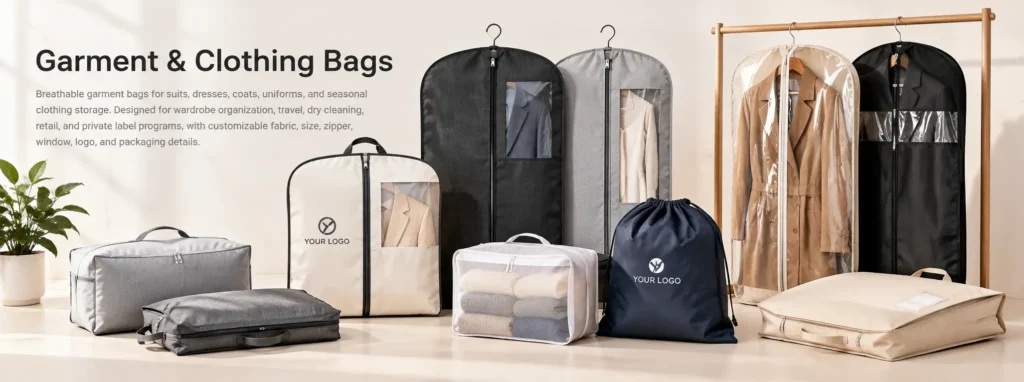
For B2B buyers, customization involves more than choosing materials, adding a logo, and setting order quantities. Clear specifications, suitable materials, accurate dimensions, consistent quotations, and approved samples and quality standards are essential to avoiding sizing issues, unsatisfactory printing, poor functionality, and unexpected costs.
Before placing an order, buyers need to know what information to prepare, how to confirm specifications with manufacturers, evaluate quotations, and reduce mass-production risks.
This article covers four key areas: procurement decisions, engineering design, product customization, and supplier management.
Clarify Your Customization Needs
Before contacting a garment bag manufacturer, it is advisable to first clarify the intended use of the garment bags, the target users, the required quantity, and the project budget. This information will directly influence material selection, bag structure, and the customization approach.
Determine the intended use scenarios for the garment bag
Requirements for garment bags vary across different application scenarios.
- Apparel brands and retail packaging: Focus on brand image, logo printing, color consistency, and packaging presentation
- Dry cleaning and laundry services: Key considerations include garment identification, ease of pickup and return, daily operating costs, and actual turnover frequency.
- Travel and clothing storage: Focus primarily on bag dimensions, zippers, handles, garment-opening openings, and portability.
- Hotel and corporate uniform management: Focus should be placed on standardizing specifications, categorizing garments, implementing label management, and ensuring the stability of bulk supply
- Wholesale and private-label programs: Key considerations include product standardization, customization capabilities, procurement costs, and the need for continuous supply
Before finalizing the product design, it should be clearly defined whether the garment bag is intended primarily for short-term packaging, daily turnover, or long-term storage. If multiple uses are intended simultaneously, the priority of the most critical function should also be determined to avoid introducing unnecessary design elements and costs merely to accommodate every possible scenario.
Should you choose a standard model or a fully custom-made one
Not all projects need to be designed from scratch.If the existing standard model already meets the requirements for dimensions, materials, and functionality, selecting the standard specification directly may make it easier to control development time and procurement costs.
If the standard model cannot meet specific garment sizing, brand color, logo placement, or structural requirements, a custom solution may be considered.
During procurement, requirements can be categorized into three levels:
| Customized hierarchy | Common adjustment items | Applicability |
| Basic Customization | Logo, color, label | The product specifications generally meet the requirements. |
| Custom Specifications | Dimensions, fabric, zipper, and handle | Requires adaptation to specific garments or usage scenarios. |
| Deep customization | Specialized design, multiple functions, exclusive packaging | There is a clear need for product development or brand initiatives. |
The actual scope of customization depends on the manufacturer’s equipment, process capabilities, and material supply capacity. Before placing an order, confirm which adjustments can be implemented and whether they will affect the minimum order quantity, price, and delivery lead time.
Define the budget, quantity, and delivery lead time
The procurement budget should take into account not only the unit price of the garment bags but also costs for sampling, printing, packaging, transportation, and other applicable expenses.
At the same time, the estimated procurement quantity, whether delivery in batches is required, whether any follow-up orders are needed, and the required time for product arrival should be determined.
This information helps manufacturers determine the most suitable production solution and provides quotations with greater reference value.
How to Choose Materials for Custom-Fitted Clothing Bags
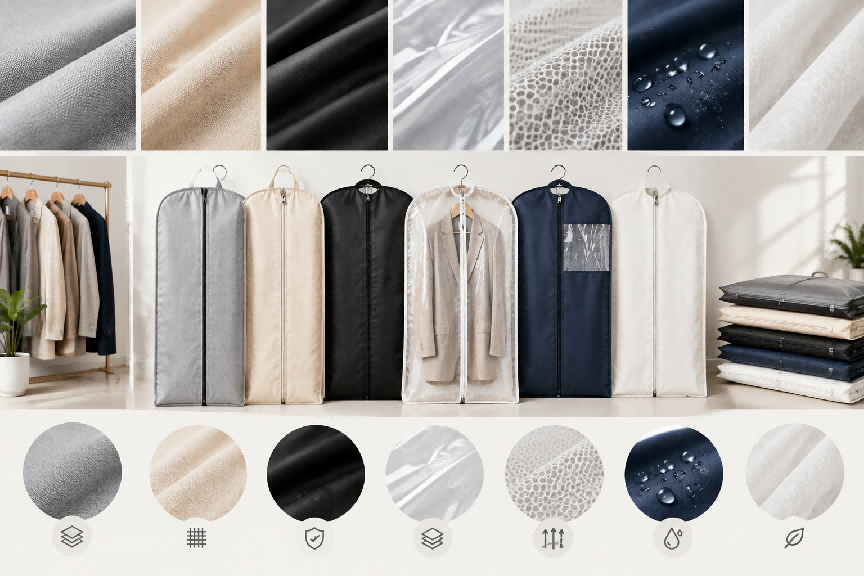
Materials determine the appearance, weight, tactile feel, and certain functional performance of garment bags. When selecting materials, one should take into account the intended use, product positioning, and cost objectives simultaneously, rather than judging their quality based solely on the material’s name.
Common materials for clothing bags
non-woven fabrics
Non-woven garment bags are generally lightweight; they are available in various grammages, colors, and surface finishes, making them suitable for certain retail packaging applications, everyday dust protection, and bulk storage needs.
When procuring, verify the fabric weight, color, surface texture, sewing method, and expected frequency of use. If the product is intended for repeated use, pay particular attention to the bag seams, zipper joints, and overall structure.
polyester fibre
Polyester fabrics offer a variety of fabric structures and processing options and are commonly used for travel clothing bags, reusable storage bags, and branded custom products.
Different polyester fabrics may vary in thickness, softness, wear resistance, and surface finish. When procuring, verify the specific fabric specifications and determine whether a coating or other surface treatment is required.
Cotton fabric and canvas
Cotton fabric and canvas are suitable for products that emphasize the texture of natural fibers, the brand image, or a relatively substantial appearance.
For this type of material, factors such as fabric weight, finished-product weight, shrinkage risk, washing and care requirements, and sewing construction must be taken into account. If the garment bag is intended to hold relatively heavy clothing, the structural design of the handles and connection points should also be verified.
Transparent plastic material
Transparent materials make it easy to identify the garments inside the bag and can be used in certain retail settings, for short-term dust protection, and for garment turnover scenarios.
However, transparency does not equate to breathability, nor does it imply that the product possesses specific moisture-proof or long-term storage capabilities. If the product has explicit protection requirements, the specific materials, thickness, structure, and relevant testing criteria should be verified.
How to determine material specifications
Simply stating “nonwoven fabric,” “polyester,” or “transparent material” is generally insufficient to constitute a complete procurement specification.
It is recommended that the following information be confirmed based on the actual product requirements:
- Material type and specific specifications
- Nonwoven fabric weight, or the weight, thickness, and structure of other fabrics
- Fabric color and surface treatment requirements
- Is a coating, transparent window, or other special component required?
- Are there any performance requirements regarding breathability, water repellency, wear resistance, or reusability?
- Are any specific tests, documents, or certificates of conformity required?
Not every project requires all parameters. The key lies in identifying which performance aspects will affect actual use and translating them into requirements that can be verified or tested.
How to strike a balance between cost and performance
Thicker materials or more complex structures do not necessarily mean that a product is more suitable.
For example, short-term retail packaging may place greater emphasis on portability, appearance, and cost; travel garment bags used frequently may, conversely, require greater attention to the durability of zippers, seams, and handles.
It is recommended that you first clarify the performance requirements that must be met, and then compare different material options. For options that have not yet been finalized, you may request samples or alternative solutions from the manufacturer; after evaluating the actual differences, you can make a decision.
Confirm the size, structure, and functionality of the garment bag
Dimensions and structure are key engineering considerations that must be prioritized during the development of custom clothing bags. Even if the materials and appearance meet expectations, if the bag body cannot accommodate the intended garment, the product will still be unable to function properly.
How to determine the correct finished product dimensions
First, determine the type of clothing that the garment bag needs to accommodate, and measure the length and width of the clothing under actual use conditions.
For hanging garment bags, you need to consider the length from the garment’s hanging position on the hanger to the bottom hem, the shoulder width, and the space required once the garment has been placed inside the bag. It is recommended that you confirm the dimensions by following these steps:
- Select representative target garments and clearly define the style and size range
- Measure the length and width of the garment, as well as any protruding parts that may affect the bag’s internal space.
- Determine the length and width of the bag body, as well as the side depth when necessary.
- Confirm the hanger opening, zipper position, seam allowance, and bottom structure
- Create a sample and actually place it in clothing to check whether there is sufficient space.
- Enter the confirmed finished product dimensions and permissible deviations into the specification document.
Please note that the flat-laid dimensions of the bag body do not exactly equal the available internal space. Sewing construction, hemming, and side panels all affect the actual capacity; therefore, it is not advisable to judge the final fit based solely on two-dimensional dimension drawings.
How to Choose Between Flat Structures and Structures with Side Enclosures
Flat clothing bags have a relatively simple structure and are suitable for scenarios where thickness requirements are not stringent and where the primary purposes are coverage and dust protection.
Side panels or extended structures can provide additional storage space, making them suitable for thicker garments or products that require specific internal space.
However, adding side panels may also increase material consumption, production complexity, and packaging volume. Therefore, whether side panels are necessary should be determined based on the garment thickness, actual capacity, and cost objectives.
How to configure zippers, handles, and garment hanger openings
When selecting a zipper, it is important to confirm its length, opening and closing direction, installation location, and expected frequency of use. For products that are frequently opened and closed, the smoothness of the zipper and the quality of its stitching are particularly important.
The handle should be evaluated in conjunction with the weight of the garment bag, the method of carrying it, and its structural design. If the product is intended to carry relatively heavy garments, the method of connection between the handle and the bag body should be confirmed, and necessary testing should be conducted based on actual usage conditions.
The opening of the hanger should be compatible with the type of hanger intended for use, while also balancing hanging convenience with the protective requirements of the bag body.
Other features, such as transparent windows, additional pockets, labels, and ventilation designs, should be determined based on the intended use. For each additional feature, it is necessary to consider whether it genuinely addresses a practical need and whether it will increase costs or affect the structure.
Translate performance requirements into acceptance criteria
Descriptions such as “sturdy and durable,” “accurate dimensions,” or “clear printing” are relatively broad in scope and are insufficient on their own to serve as a complete basis for acceptance inspection.
The purchaser shall further specify the items requiring inspection based on the actual intended use. For example:
- Finished product length and width, and permissible deviations
- Fabric specifications, color, and surface finish
- Does the zipper open and close smoothly?
- Are there any obvious defects in the joint?
- Whether the handles and connection points meet the agreed load-bearing requirements
- Does the logo’s size, placement, and color match those of the approved sample?
If the project involves special performance requirements, the testing methods and acceptance criteria should be established before the order is placed, rather than being proposed only after production has concluded.
What should be confirmed regarding logo printing, brand colors, and packaging
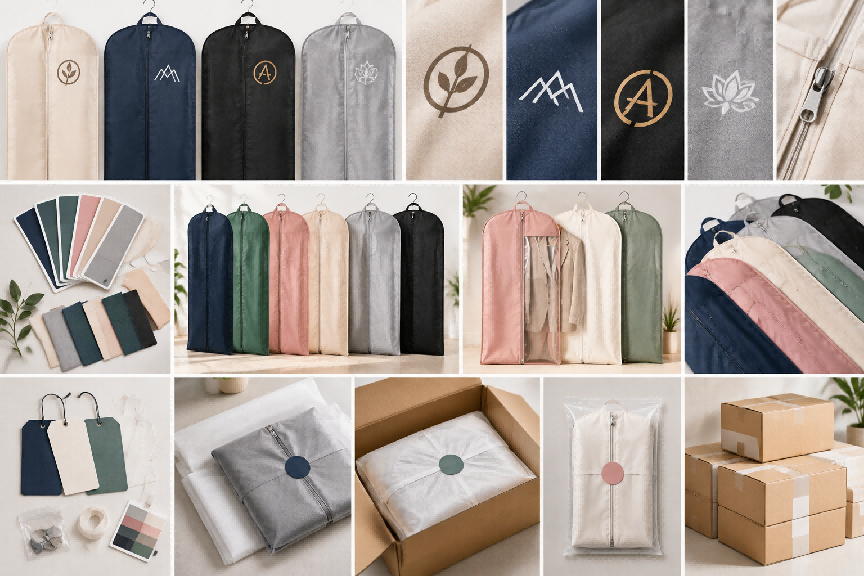
For apparel brands and private-label customers, visual consistency is a critical component of customized procurement. Printing files, fabric colors, labels, and packaging should be confirmed as thoroughly as possible before sample production.
Prepare the logo file and confirm the printing location
The purchaser shall provide clear brand logo files, specifying the print dimensions, placement, colors, and intended visual effect.
If the logo involves multiple colors, small text, or special processing techniques, the manufacturer should be consulted in advance to confirm the feasibility of the process. Different fabric surfaces may affect the printing results; therefore, the final product should not be judged solely based on digital mockups.
It is recommended that, during the sample stage, verify whether the logo is clear, whether its placement is correct, whether the colors meet expectations, and whether the print quality is compatible with the target material.
Verify consistency between the fabric color and the brand specifications
If the product is required to conform to a specific brand color, the color reference standard should be clearly specified, and the method for confirming the actual fabric color should be confirmed with the supplier.
For projects involving multiple sizes, different production batches, or continuously recurring orders, the criteria for determining color deviation should also be established to reduce the risk of significant differences between different batches.
Plan the specifications for individual packaging and outer cartons
The packaging solution may affect product protection, warehousing, case dimensions, and transportation costs.
Before procurement, determine whether individual packaging, barcodes, product labels, specified carton quantities, or specific outer carton markings are required.
If transportation costs are closely related to the volume of the goods, the supplier should also be required to provide estimated packaging dimensions and packing information, so that logistics costs can be estimated in advance.
Costs, minimum order quantities, and lead times for custom clothing bags
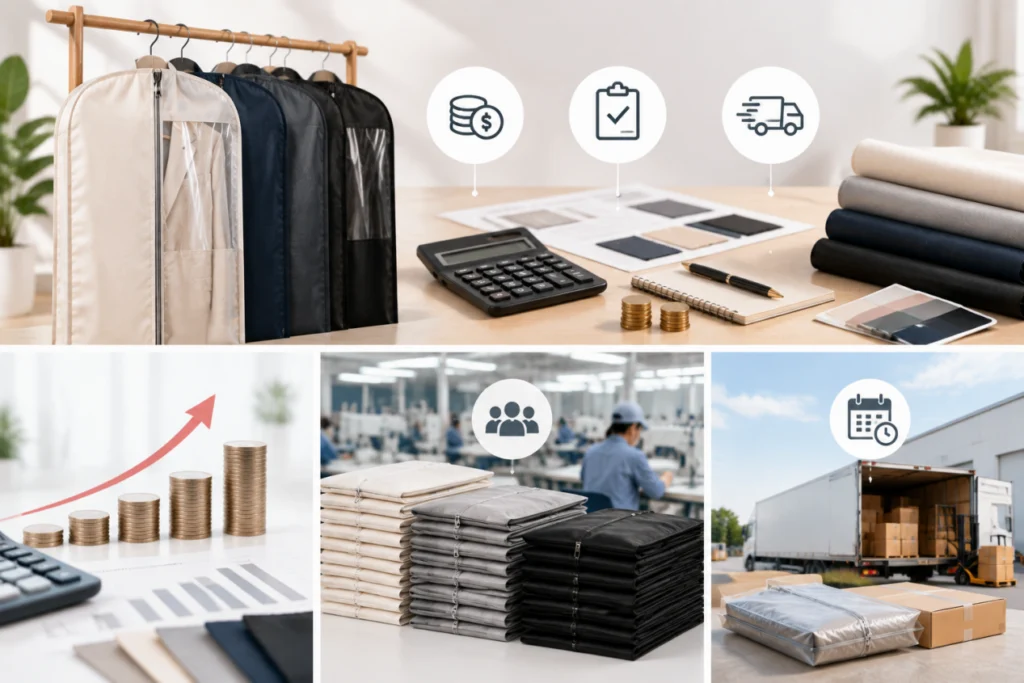
Quotes for custom garment bags typically depend on factors such as materials, dimensions, construction, accessories, printing, packaging, and order quantity. When procuring, ensure that quotes from different garment bag suppliers are based on comparable specifications and delivery terms.
Which factors affect the unit price
The primary influencing factors include:
- Materials: type, weight per unit area, thickness, color, and special treatments
- Dimensions: finished product area, material consumption, and cutting layout
- Structure: Is side panels, pockets, reinforcement structures, or special openings required?
- Accessories: zipper, handle, label, and other attachments
- Printing: logo size, number of colors, and specific printing process
- Packaging: individual packaging, labeling, carton arrangement, and outer carton requirements
- Quantity: Material procurement, production scheduling, and allocation of processing costs
When the budget is limited, priority should be given to optimizing non-essential features, packaging complexity, and specification combinations, rather than directly reducing material or structural requirements that impact the product’s core performance.
How should the MOQ be confirmed
Minimum order quantities may vary depending on the manufacturer, materials, and custom fabrication process. Projects using existing materials and standard structures may have different minimum order requirements than those requiring special colors, dedicated printing, or complex structures. When requesting a quote, be sure to confirm the following:
- Minimum order quantity for each product
- Are quantities calculated separately for different colors or sizes?
- Can multiple styles be purchased together?
- Are there any sample fees, plate-making fees, or other one-time charges?
- Will subsequent follow-up orders continue to be subject to the same minimum order quantity requirements?
Do not assume that a particular quantity constitutes the industry-wide minimum order quantity simply because you have not verified the supplier’s requirements.
How to determine the sample production cycle and batch delivery lead time
Project timelines typically encompass stages such as requirements confirmation, material preparation, sample fabrication, sample revision, pre-production validation, batch production, and transportation.
It is recommended that, when requesting a quote, you separately confirm the sample lead time and the batch production lead time, and ask which milestone triggers the calculation of the delivery date—for example, whether it begins upon order confirmation, upon sample approval, upon receipt of the deposit, or upon material confirmation.
If the project has a clearly defined launch date, time should be reserved for sample modifications and transportation, and the delivery arrangements mutually agreed upon by both parties should be confirmed in the order.
Don’t just compare the unit price of products
Even when both quotations pertain to garment bags, they may differ in terms of material specifications, dimensions, accessories, printing, packaging, and acceptance criteria.
When comparing products, product specifications and order terms should first be standardized, after which the unit price, additional costs, packaging, and transportation costs should be verified.
For bulk procurement, a comprehensive assessment should also be conducted by taking into account the expected service life, rework risk, quality stability, and replenishment capacity, rather than simply selecting the supplier with the lowest quoted price.
How to evaluate manufacturers and verify prenatal samples
Whether a garment bag manufacturer can accurately understand requirements, consistently execute specifications, and deliver as agreed is just as important as providing a quote.
Assess the manufacturer’s production and customization capabilities
When evaluating suppliers, it should be confirmed that they possess the production capacity required for the target materials, dimensions, structures, and printing processes.
You may inquire about the supplier’s relevant product experience, sample development procedures, quality control methods, production schedules, and procedures for handling abnormalities. For special materials or functional requirements, you should further confirm whether the supplier can provide the corresponding material documentation or test evidence.
Why is it necessary to verify samples before mass production
Samples enable the purchaser to inspect the materials, dimensions, structure, accessories, and brand performance on the actual product.
It is recommended that the sample be compared item by item with the confirmed specification sheet, including:
- Material type, color, and surface finish
- Finished product dimensions and structure
- Zippers, handles, and other accessories
- Logo placement, size, and print quality
- Seams, edges, and overall craftsmanship
- Individual packaging and appearance labeling
If the sample requires modifications, the specific issues, modification requirements, and confirmed results shall be documented, and batch production shall be scheduled only after the final sample has been approved.
Establish clear quality control standards
Quality standards should be established before production, rather than being discussed only after the finished product has been delivered.
The purchaser may specify dimensional tolerances, appearance requirements, accessory functionality, sampling inspection methods, and other necessary acceptance criteria based on the intended use of the product.
For repeat procurement projects, it is recommended that approved samples, specification sheets, printed documents, and acceptance records be retained to ensure consistency when submitting follow-up orders.
What information should be included in a quotation request form for custom clothing bags
A clear quotation request helps manufacturers accurately understand requirements, reduce communication costs, and provide comparable quotes. It is recommended that the following information be included:
- Product requirements: usage scenarios, garment type, materials, colors, and finished product dimensions
- Structure and customization: zippers, handles, garment hanger openings, logo printing, and label requirements
- Procurement and Packaging: Total order volume, specification allocation, packaging method, and case packing requirements
- Quality standards: dimensional tolerances, appearance requirements, functional testing, and acceptance criteria
- Delivery lead time and quotation: sample confirmation time, production cycle, estimated delivery date, and related costs
If complete technical drawings are not yet available, you may first provide reference images, garment samples, or preliminary dimensions, and then confirm the specific specifications with the manufacturer.
Common Errors in the Procurement of Customized Clothing Bags
Only product images are provided; no specific specifications are available
An image can convey a general appearance, but it cannot fully specify the material, dimensions, structure, and permissible deviations.
How to avoid this: Integrate images with size tables, material requirements, functional specifications, and quality standards to prevent different personnel from developing divergent interpretations of the same image.
Only the material name was confirmed; the specific specifications were not confirmed
The same material may have different grammages, thicknesses, fabric structures, and surface treatment methods.
How to avoid this: Clearly define the material parameters required for actual use and verify them through samples or relevant documentation.
Proceed directly to mass production without verifying the dimensions
Even if the bag’s dimensions appear reasonable, they may still not fit the actual clothing items.
How to avoid this: Try on representative clothing items and verify the finished garment’s dimensions, construction, and available space.
Focus only on the lowest bid
Different suppliers may provide different materials, accessories, packaging, or quality standards.
How to avoid this: standardize specifications, quantities, and delivery terms, then compare prices and overall procurement costs.
The final sample has not been approved
Confirming a product solely through text or digital renderings may result in the omission of differences in material texture, actual dimensions, printing effects, and other factors.
How to avoid this: Complete physical sample confirmation before mass production and retain the final approval records.
No agreed-upon quality and delivery standards
If the dimensional tolerances, appearance requirements, delivery dates, and packaging methods have not been explicitly specified, disagreements are likely to arise during subsequent acceptance inspection.
How to avoid this: Include the key requirements in the specification documents and purchase orders, and ensure that both parties use the same acceptance criteria.
Frequently asked questions
What elements can be customized in a custom garment bag?
Depending on the manufacturer’s production capacity, materials, dimensions, colors, structures, zippers, handles, logos, labels, and packaging can be customized. The actual range of options should be confirmed with the supplier based on the project requirements.
Must complete design drawings be provided when requesting a quote?
Not necessarily. A complete design drawing helps ensure an accurate quotation; however, if you are still in the product development stage, you can first provide the intended use, reference images, garment dimensions, material preferences, and estimated quantities, and then work with the manufacturer to gradually confirm the technical specifications.
What is the MOQ for custom clothing bags?
There is no uniform minimum order quantity (MOQ) applicable to all products. Specific requirements depend on the manufacturer, materials, color, structure, printing process, and order combination. When requesting a quote, confirm whether the minimum order quantity is calculated separately for each design, color, or specification.
Is it necessary to confirm the sample before mass production?
For custom dimensions, special materials, branded printing, or large-batch orders, it is recommended that a physical sample be confirmed in advance. This allows specification and appearance issues to be identified early, thereby reducing the risk of rework during mass production.
How can the procurement costs for custom-made garment bags be reduced?
Costs can be controlled by clearly defining core requirements, selecting appropriate materials, reducing unnecessary components, optimizing dimensions and packaging, and rationally arranging procurement quantities. However, it is not advisable to directly reduce the requirements for critical materials or structural elements without first assessing the impact on their use.
Only by defining specifications clearly can customized garment bags be procured more effectively.
The procurement of custom-made garment bags involves materials, dimensions, structure, brand customization, cost, quality control, and delivery arrangements. The more thorough the preparations made before procurement, the easier it is to obtain an accurate quote, suitable samples, and batches of products that meet expectations.
It is recommended that the process begin with the intended use case, followed by a step-by-step confirmation of material specifications, finished-product dimensions, functional configurations, logo files, procurement quantities, and acceptance criteria; sample review should be completed prior to mass production.
Are you looking for custom garment bags tailored to your project
If you need custom garment bags developed for a clothing brand, retail business, dry-cleaning service, or corporate uniform product project, you may provide the following information:
- Intended use and type of garment
- Expected material and finished product dimensions
- Required structure, zipper, handle, and other features
- Logo, color, and packaging requirements
- Estimated procurement quantity and delivery schedule
Contact us to discuss your product specifications and customization requirements, and to further evaluate feasible materials, structural designs, sampling options, and quotes for mass production.