
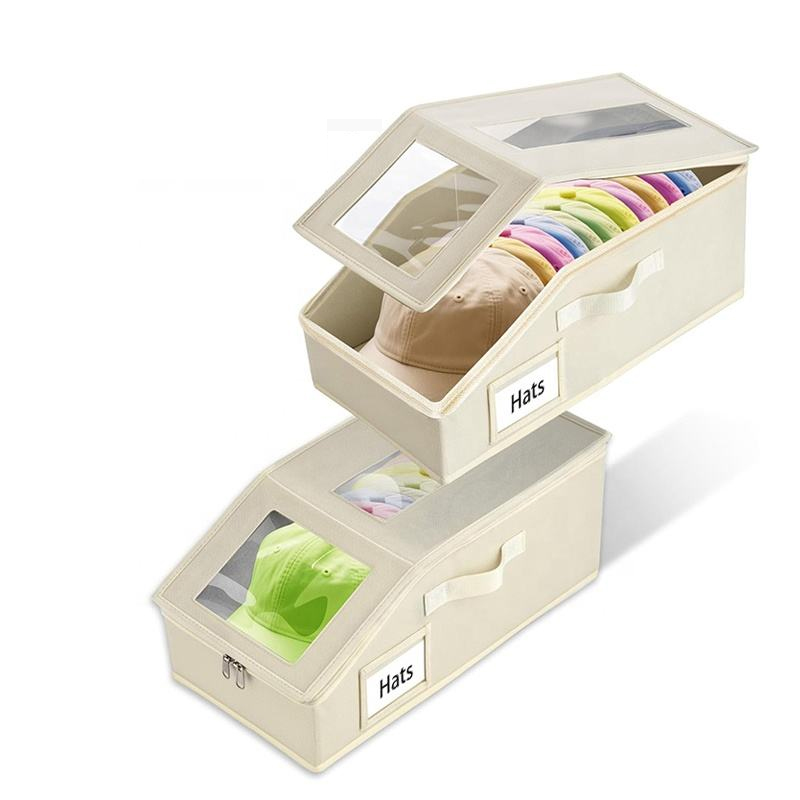
Baseball caps, sport caps, bucket hats, and wide-brimmed hats each have a distinct shape. As the number of hats increases, simple stacking often leads to difficulties in locating items, pressure on the hat shapes, and inefficient use of space. For consumers seeking to improve the effectiveness of wardrobe organization, as well as for brands, wholesalers, and importers developing home storage products, selecting the appropriate hat storage box requires consideration not only of capacity but also of internal dimensions, box structure, opening design, and practical usage methods.
Stackable hat storage boxes with transparent windows help users identify the hat styles inside the box while making use of the vertical space in wardrobes or storage racks. However, a transparent window does not mean that the container is completely airtight, and stackability does not imply that items can be stacked indefinitely. When selecting a product, the choice should be based on the target hat styles, storage environment, and product structure.
What primary problems does a hat storage box address
Hats may appear compact, but different styles have markedly different storage requirements. The crown and brim of a baseball cap should be protected from excessive compression; soft bucket hats are relatively easy to organize, whereas wide-brimmed hats or styles with decorative elements generally require more storage space.
If all the hats are stacked directly on top of one another, the bottom hat may be difficult to remove, and the crown and brim may also be compressed. For users who own a wide variety of styles, an opaque storage box will further increase the time required to locate the desired hat.
The value of a hat storage box lies in combining categorization, storage, and retrieval. Before making a purchase, you should first determine which types of hats you primarily need to store; then decide on the appropriate box size, the type of opening, and whether a transparent window or stacking function is necessary—rather than simply focusing on how many hats the box can hold.
What are the functions of transparent windows and stackable designs
Transparent window: facilitates identification and classification
A hat storage box with a transparent window allows users to view the color and part of the exterior of the hats inside without having to open the box. For households that own hats in multiple colors, styles, or seasonal varieties, this design helps reduce the need to repeatedly open the box to search for them.
In practical use, items can be sorted by hat type, frequency of use, or family member, with labels such as “sports hat,” “daily hat,” and “winter hat” attached to the exterior of the box. The transparent window, together with these labels, makes the categorization more intuitive.
It should be noted that the visible area of a window depends on the window size, the way the cap is placed, and the available space inside the box. If caps are stacked and partially obstruct one another, or if the window is small, labels may still be required to aid identification.
The lided design also helps reduce the likelihood that the cap will be directly exposed to the everyday environment; however, whether a product is fully dustproof, waterproof, or airtight cannot be determined solely by the presence of a transparent window. The actual performance also depends on the lid, the opening, and the overall structure.
Stackable design: Utilizing vertical space
As the number of hats increases, multiple storage boxes can be arranged according to the available space in the wardrobe or storage rack, reducing the need to scatter hats and other accessories.
Before purchasing, measure the width, depth, and height of the storage area, and allow sufficient space for opening the lid, pulling out items, and retrieving them. If the storage box is placed high up, also consider whether it will be easy to remove after items have been loaded; if it is placed deeper within a cabinet, check whether the opening and access path are convenient to use.
Stackable hat storage boxes also require attention to structural stability. Whether the top and bottom of the box are level, whether the box maintains its shape after hats are placed inside, and whether it slides easily when stacked all affect its practical usability. The number of hats that can be stacked should be determined based on the product design and instructions, rather than solely according to the remaining height of the wardrobe.
How to Choose the Right Storage Box for Different Hat Styles
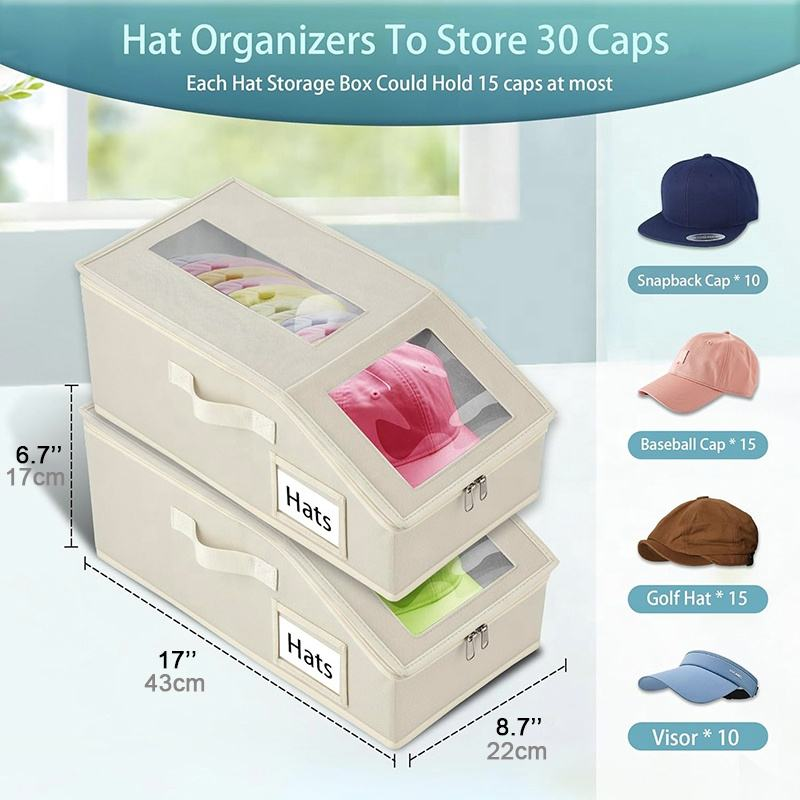
The shape of the hat directly affects the internal space required for the storage box. For household users, rational categorization helps reduce crowding; for brand owners and purchasers, defining the target hat type facilitates the determination of product dimensions and structure.
| Hat style | design feature | Key Considerations for Storage Box Specifications | Storage Tips |
| Baseball caps and sport caps | The crown provides a certain degree of structural support, and the brim has a relatively well-defined contour. | Internal width, height, and required space for the hood | Avoid pressing against the crown or brim; styles intended to maintain their shape should be stored separately. |
| Fisherman’s hats and soft-cap hats | Some fabrics are soft and have relatively weak structural support. | Is the interior space suitable for placing the hat naturally, and does it require additional support? | They can be categorized by season, material, or purpose; whether they are foldable should be determined by referring to the hat’s construction and care instructions. |
| Wide-brimmed hats and decorative hat styles | The brim is relatively wide, and some styles feature prominent decorative elements. | The actual outer diameter of the hat, its overall height, and the available space for decorative elements | Leave sufficient space to prevent the brim from being compressed; different storage boxes of varying sizes can be used for different hat styles. |
For bulk purchases or custom-made hat storage boxes, it is recommended that you first measure the actual dimensions of the target hat style, then determine the internal length, width, and height of the storage box, as well as any necessary support structure. If the product needs to be compatible with multiple hat styles, loading verification should be conducted using representative samples; avoid determining specifications based solely on the hat’s name or nominal size.
Key details to check when selecting a hat storage box
Is the internal dimension appropriate
The external dimensions of a storage box do not equal its actual usable space. The box walls, lid, and internal structure can all occupy some space; therefore, you should not rely solely on the length, width, and height indicated on the product label.
It is recommended that you first measure the maximum width of the hat, the outer diameter of the brim, and the overall height, then verify these measurements against the interior dimensions of the storage box. If you need to store multiple hat styles, prioritize using the larger-sized hats that are more difficult to adjust in shape for initial compatibility assessment.
At the same time, measure the available space in the wardrobe or storage unit to ensure that its external dimensions will not interfere with the closing of the cabinet doors, the placement and retrieval of items, or routine operation.
Whether the material is compatible with the box structure
Hat storage boxes may be made of plastic, fabric, or other structural materials. Different materials each have distinct characteristics in terms of transparency, flexibility, support, cleaning methods, and storage convenience.
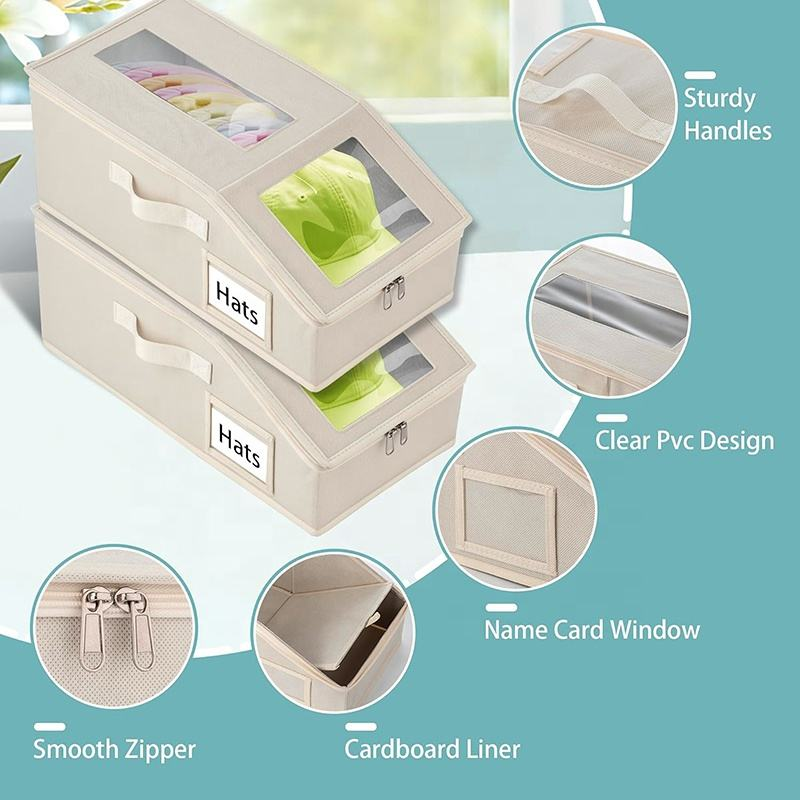
If internal visibility is a priority, attention should be paid to the dimensions, clarity, and connection method of the transparent window; if the product is intended to be foldable for storage, it is necessary to confirm the folding mechanism and whether it can maintain its intended shape after being unfolded.
The name of a material alone cannot fully indicate product quality. Material thickness, seams, connection structures, and overall design also influence actual performance in use. When procuring, decisions should be based on the intended use of the product and the condition of samples, rather than made solely on the basis of appearance.
Is it easy to open for placing and removing items
Even when the case dimensions are adequate, an unsuitable opening design can still affect the user experience. If the opening is too small, wide-brimmed hats or hats with a relatively high crown may be difficult to place inside; likewise, if the case lid’s opening mechanism does not match the item’s placement position, the user may need to move other items first.
Therefore, when making a purchase, you should also check the internal dimensions, the actual opening size, and the way the lid operates. For hats that need to be accessed frequently, priority should be given to a convenient placement and product design that facilitates easy retrieval.
Can it remain stable after stacking
If you plan to purchase multiple storage boxes, verify whether the product explicitly supports stacking and whether boxes of the same specifications can be arranged and combined as intended.
During inspection, check whether the top and bottom surfaces are level, whether the box body deforms after loading, and whether the boxes slide easily when stacked together. The specific load capacity and recommended stacking quantity should be determined based on the product design, instructions, and actual verification results; they should not be inferred arbitrarily.
B2B Procurement: From Product Selection to Mass Production
For home organization brands, retailers, importers, and wholesale buyers, the development of hat storage boxes should begin with the target market and actual usage scenarios, rather than determining product specifications directly based on reference images.
Define the target cap type and product specifications
Before development, it should be confirmed whether the target users primarily store baseball caps and sport caps, or whether they need to accommodate a variety of styles, including wide-brimmed hats and children’s hats. This information will affect the enclosure dimensions, opening design, location of the transparent window, and available interior space.
If you plan to develop a product line, you can define multiple specifications based on different cap styles and clearly specify the applicable scope for each specification. This approach is more conducive to product positioning and inventory planning than simply increasing the capacity of a single box.
Verify the sample using the actual cap design
Sample verification should not be limited to visual inspection alone. It is recommended that the target cap model be used for actual loading, with particular attention paid to the following items:
- Fit: Whether the hat can be naturally put on and taken off, and whether the brim and crown are noticeably compressed
- Opening and closing: Whether the lid is easy to open and close; whether the transparent window aids in identifying the cap style.
- Housing shape: After loading, can the housing maintain its intended shape, and are the openings and connection points functioning properly?
- Stacking performance: Whether multiple boxes remain stable when stacked, and whether they slide easily or undergo noticeable deformation
- Packaging and transportation: the packaging dimensions of individual products, the folding or disassembly method, the capacity of the outer carton, and the risk of crushing that may occur during transportation
Specific testing items should be determined based on the product structure and the intended use scenarios; a product cannot be deemed suitable for mass production solely on the basis of a single visual inspection.
Translate the validation results into production specifications
Once the sample has passed inspection, the critical dimensions, materials, transparent window structure, opening and box-cover configuration, stacking requirements, and packaging method shall be documented in written specifications to serve as the basis for subsequent production and quality inspection.
If the materials, structure, or critical dimensions are adjusted prior to mass production, these changes should be re-evaluated to determine whether they affect internal space, housing geometry, opening and closing operation, and stacking stability. For products requiring long-term procurement or multiple replenishment batches, clearly defined specifications also help reduce variations between different batches.
The packaging solution should also be confirmed in advance. For foldable or assembly-required storage boxes, the delivery status, individual-item packaging, and outer carton capacity should be clearly defined to facilitate the assessment of warehousing, transportation, and retail display requirements.
Frequently Asked Questions
Are hat storage boxes with transparent windows suitable for all types of hats?
Not necessarily. Wide-brimmed hats or hats that require a specific shape may need more interior space; therefore, the choice should be based on the actual dimensions.
Can stackable hat storage boxes be stacked infinitely?
No. A reasonable stacking method and quantity should be determined based on the product structure, loading conditions, and product specifications.
Can a transparent window provide complete dust protection?
The dust-proof performance cannot be judged solely based on the transparent window; the box lid, openings, and overall structure must also be taken into consideration.
What information should be verified before procurement for B2B purposes?
It is recommended that the target cap type, internal and external dimensions, materials, opening structure, stacking requirements, sample validation items, and packaging specifications be clearly defined.
Begin model selection with actual cap designs
When selecting a hat storage box, the key is not simply to increase capacity, but to ensure that hats are stored appropriately, are easy to access, and fit the actual storage space. For brand owners and purchasers, it is essential first to define the target hat styles, then use samples to verify dimensions, structure, and stacking performance, and finally finalize written specifications; only in this way can product design remain aligned with the requirements of mass production.