
Closet organizers are essential tools for optimizing wardrobe space, organizing clothing, and improving storage efficiency. Whether in home wardrobes, dormitories, apartments, hotels, or retail spaces, the right organizers help users make full use of vertical space while keeping clothing, shoes, and accessories neatly arranged.
However, when faced with products of varying sizes, materials, structures, and installation methods, selecting the optimal wardrobe storage unit is not always straightforward. For average consumers, the primary considerations are whether the product is practical, easy to install, and capable of meeting everyday storage needs; for importers, wholesalers, retail brands, and procurement managers, product structure, material performance, production consistency, customization capabilities, and bulk procurement costs are equally important.
This guide will assist purchasers in clarifying selection requirements and assessing product suitability across dimensions such as product type, size, materials, structural design, and quality control; it will also help them confirm key specifications and acceptance criteria prior to bulk procurement.
Learn about different types of wardrobe storage organizers
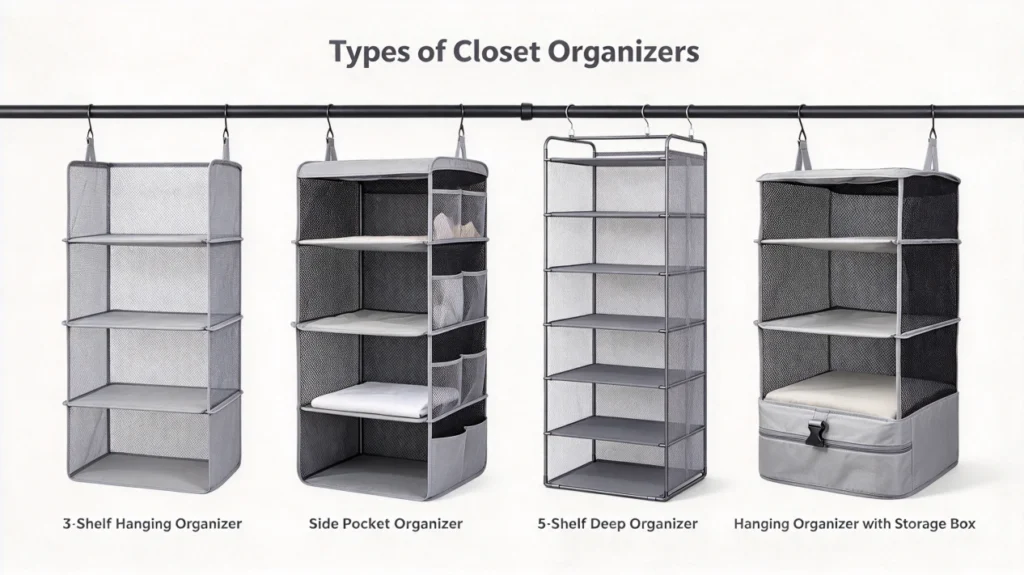
Closet storage racks come in a variety of structural designs, each offering distinct advantages in terms of space utilization, item classification, and modes of use. For buyers, wholesalers, and brand clients, the appropriate product type should be selected based on the usage requirements of the target market, wardrobe space, and budget.
| Storage rack types | main features | applicable scene | Key Considerations for Procurement and Product Selection |
| Hanging wardrobe storage rack | Secure it to the wardrobe rod using a strap or hook, making use of vertical space for multi-tiered storage. | Bedrooms, dormitories, apartments, and shared wardrobes | Overall dimensions, number of compartments, fabric, hanging structure, load capacity, and customization options |
| Drawers-style wardrobe storage rack | Equipped with independent drawers or tiered storage compartments, making it convenient to organize and store small items by category. | Organization of underwear, socks, accessories, and daily necessities | Drawer dimensions, opening mechanism, support structure, and durability for repeated use |
| Partitioned wardrobe storage rack | Divide storage spaces using partitions or independent zones to improve the efficiency of item classification. | Folding clothing, shoe boxes, and items of a certain size | Partition dimensions, partition layout, installation space, and space utilization |
| Foldable Wardrobe Storage Rack | It can be folded when not in use, reducing the space occupied during storage and transportation. | Seasonal storage, rental housing, and e-commerce retail | Unfolded dimensions, folding method, structural stability, packaging volume, and transportation costs |
How should you choose the appropriate product type
Hanging storage racks are ideal for users who wish to make use of vertical space in their wardrobes; they are also a suitable product category for brand procurement projects that require customization of dimensions, fabric, color, logo, and packaging. For related products, please refer to fabric hanging storage racks.
Drawer-style and compartmentalized storage units are better suited for scenarios that emphasize the categorization of small items or the organization of designated storage areas; when selecting a model, particular attention should be paid to confirming the effective storage capacity and structural stability.
Foldable storage racks are better suited for procurement projects focused on warehousing and transportation efficiency; however, logistics costs should be assessed based on the actual packaged dimensions after folding, rather than relying solely on the product’s foldable nature to determine its transportation advantages.
For wholesale procurement and OEM/ODM customization projects, it is recommended that you first define the target market, intended use cases, and storage requirements; then compare product dimensions, materials, structure, load-bearing requirements, and packaging specifications, so that a balance can be achieved among functionality, cost, and transportation efficiency.
If products of different types can each meet basic storage needs, purchasers should also compare actual storage capacity, installation convenience, individual unit packaging volume, expected service life, and unit procurement cost, and then determine the final storage rack solution based on the requirements of the target market.
Select the appropriate dimensions based on the actual available space
Dimensions are one of the most important factors when selecting a wardrobe storage unit. Even if the product’s structure and materials meet the required specifications, if the dimensions do not match the wardrobe space, it will be difficult to achieve the desired storage results.
Measure the available space in the wardrobe
Before choosing a storage rack, it is recommended that you measure the height, width, and depth of the wardrobe interior.
For suspended storage racks, it is also important to confirm the position of the wardrobe horizontal bars, the distance from the bars to the floor or shelf below, and the space required for the wardrobe doors to open and close.
These dimensions help determine the product’s overall height, width, and depth, preventing insufficient space after installation or any interference with the placement or retrieval of other garments.
For customized procurement projects, it is recommended that these requirements be translated into clear product specifications and confirmed during the sample-making stage. For bulk procurement, the overall dimensions, the effective storage dimensions of each layer, the spacing between compartments, and the permissible deviations for key dimensions should be explicitly specified in the product specifications, and a unified measurement method should be agreed upon. This will help reduce dimensional discrepancies between samples and mass-produced products and will facilitate subsequent inspection and acceptance.
Determine the compartment dimensions based on the items to be stored
Different items have different requirements for the height and width of the partition.
For example, lightweight clothing, scarves, and small accessories can generally be stored in smaller compartments; sweaters, heavier garments, or footwear may require more spacious storage.
When planning the number of intermediate levels, it is important to balance classification requirements with the actual usable space available on each floor. Having too many intermediate levels may result in insufficient floor height, while having too few may reduce classification efficiency.
For storage rack manufacturers, a well-designed compartmental layout must not only meet customers’ storage requirements but also take into account material usage, cutting layout, and sewing processes, thereby achieving a balance between functionality and production costs.
Choose a suitable material for the storage shelf
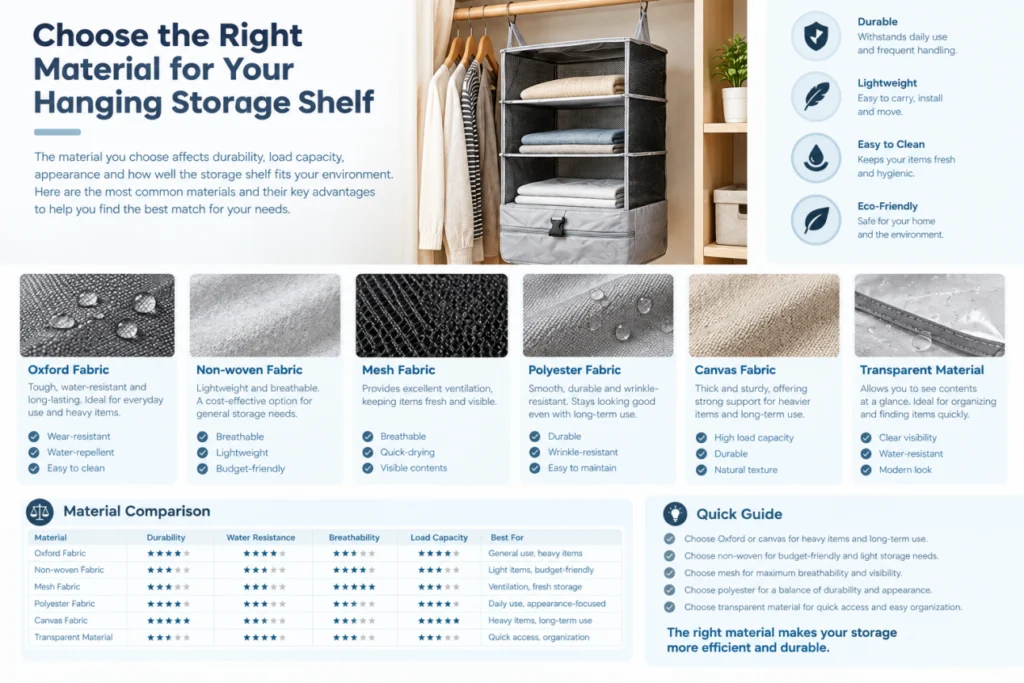
Materials affect the durability, appearance, weight, processing performance, and production cost of wardrobe storage racks. When procuring, you should select appropriate fabrics and support structures based on the product’s intended use, load-bearing requirements, frequency of use, and target cost, rather than judging quality solely by the material name or price.
| material type | main features | applicable scene | Key Considerations for Procurement and Product Selection |
| Polyester fabric | A wide range of specifications, colors, and surface finishes are available, making it suitable for a variety of fabric storage products. | Daily clothing storage and branded custom products | Fabric weight, wear resistance, dimensional stability, sewing performance, and logo printing quality |
| non-woven fabrics | Lightweight and flexible in processing, making it suitable for products where cost is a key consideration. | Lightweight storage and cost-sensitive products | Tear resistance, wear resistance, deformation performance, and reinforcement requirements for critical areas |
| Mesh fabric | Facilitates access to interior items and promotes air circulation in the appropriate design. | Side panels, visualized storage area, and local ventilation structure | Hole size, wire-binding risk, edge treatment, and connection strength |
| Composite Materials and Reinforced Structures | Different materials can be combined, or additional support components can be added, to help maintain the shape of the partition. | Products with specific requirements for structural stability and load-bearing capacity | Support materials, locations for local reinforcement, overall weight, folding performance, and production costs |
How do you determine the appropriate material
For suspended storage racks used in everyday applications, polyester fabric can serve as a common material choice; for projects that prioritize lightweight design and cost control, non-woven fabric solutions can be evaluated; and for areas where visibility or air circulation needs to be improved, a mesh structure may be considered.
If the product is intended to carry relatively heavy loads or be used repeatedly over an extended period, particular attention should also be paid to evaluating the strength of compartment supports, hanging connections, and sewing points; where necessary, localized reinforcement designs should be implemented.
For wholesale procurement and OEM/ODM customization projects, it is recommended that fabric specifications, key performance requirements, and acceptance criteria be clearly defined before sample production; the material performance should then be verified through actual samples to ensure that product performance aligns with the budget and intended application scenarios.
For batch orders, purchasers should also verify that the material specifications match those of the confirmed sample and determine the appropriate method for verifying properties such as wear resistance, tear resistance, or dimensional stability based on actual application requirements. When material performance indicators are involved, the testing methods and acceptance criteria should be agreed upon in advance, so as to avoid judging product quality solely on the appearance of the fabric or the name of the material provided by the supplier.
Evaluate structural design and load-bearing capacity
Closet storage racks must not only provide sufficient storage space but also remain stable under expected usage conditions.
Focus on the suspension system
For suspended storage racks, the hanging straps, hooks, and their connection points are critical load-bearing components.
When selecting the component, inspect the structure, fastening method, and stitching of the hanging assembly, and confirm whether the product is suitable for the wardrobe horizontal rod intended for installation.
At the same time, the wardrobe horizontal rod itself must have sufficient load-bearing capacity. The load-bearing performance of a storage shelf cannot be assessed in isolation from its installation environment.
Focus on interlayer support
The design of the partition affects the product’s user experience and appearance.
If the product needs to maintain a relatively flat compartmental shape, an appropriate support structure can be adopted based on the design. The specific solution should be determined according to the product dimensions, expected load, material properties, and folding requirements.
For custom projects, it is recommended that, during the sample stage, check whether the partitions are prone to sagging, whether the side panels remain square, and whether the product can maintain its intended shape after normal loading.
Define the requirements for load-bearing testing
Different storage racks may have significantly different load capacities; therefore, load-bearing performance should not be judged solely based on the product’s appearance, fabric thickness, or the number of compartments.
Purchasers should, based on the intended use, confirm with the manufacturer the product’s design load, testing methods, loading conditions, and acceptance criteria.
If the product is intended for the storage of heavier items, appropriate performance validation should be conducted prior to mass production, and the usage limitations for each layer and for the product as a whole should be clearly defined.
During the sample validation stage, it is recommended that particular attention be paid to inspecting the deformation of each layer under the specified load, verifying that the suspension straps are securely attached to the main body, and checking whether any significant permanent deformation, seam cracking, or structural damage occurs after unloading.
If any issues are identified during testing, the cause should be analyzed based on the location of failure, and it should be assessed whether adjustments are required to the interlayer dimensions, support structure, material specifications, or sewing reinforcement method. After improvements are made, the product should be revalidated under the agreed testing conditions; the test results should be recorded and serve as the basis for subsequent sample qualification and batch production.
Consider functional design and ease of use
In addition to basic dimensions and materials, additional features also influence the product’s range of applications.
Multi-tiered compartment design
A multi-tiered structure can divide wardrobe space into multiple sections, making it ideal for organizing folded clothing, accessories, and other everyday items.
When making a selection, pay attention to the effective dimensions of each level, the number of partitions, and whether items can be easily retrieved and placed.
Zippered storage compartment
Zippers can help seal storage spaces, making them suitable for storing items that require centralized organization.
If the product features a zippered bottom storage compartment, the opening dimensions, zipper placement, sewing quality, and whether the internal space meet actual requirements should be verified.
Visualized Storage Design
Mesh fabrics or transparent materials can help users view the items inside, reducing the time spent searching.
This type of design is suitable for storage scenarios that require rapid item identification; however, the specific materials should still be selected based on durability, appearance, and the intended environment of use.
Easy Folding and Easy Packaging Design
For wholesale and retail products, folding structures and packaging methods are also important design considerations.
An appropriate folding method can reduce the product’s packaging volume; however, it must also ensure that, once unfolded, the product returns to its intended shape and that the packaging process does not damage the fabric, zipper, or hanging components.
What should be considered when engaging in wholesale procurement and customized production
For importers, wholesalers, retailers, and private-label customers, selecting the appropriate wardrobe storage units requires not only meeting operational needs but also taking into account the target market, procurement costs, and mass-production requirements.
Define product specifications
Before requesting a quotation, the overall product dimensions, compartment configuration, fabric specifications, hanging structure, color, logo, and packaging label requirements should be clearly defined. Clear product specifications help manufacturers assess material consumption, production processes, and costs, while also improving the comparability of quotations from different suppliers.
Confirm the customization scope
OEM/ODM projects can work with manufacturers to confirm customized specifications for dimensions, compartment layout, fabric, color, brand logo, and packaging, based on the requirements of the target market. It should be noted that changes to dimensions and structural configurations may affect material utilization, production labor hours, packaging volume, and final cost; therefore, the practicality and production feasibility of the design should be assessed before sample production.
Sample Evaluation and Quality Control
Prior to mass production, it should be confirmed that the sample complies with the agreed specifications, and the product dimensions, fabric quality, sewing process, hanging and fastening, zipper functionality, logo appearance, and packaging integrity should be inspected. For products subject to weight requirements, the testing methods and acceptance criteria should also be clearly defined. Once the sample has been confirmed, the final specifications and quality requirements should be documented in writing and serve as the basis for mass production and shipment acceptance.
Compare overall procurement costs
The evaluation of suppliers of suspended storage racks should not be limited to individual item quotations; it should also take into comprehensive consideration material specifications, structural complexity, customization requirements, packaging methods, and order quantities, as well as the minimum order quantity, sample-making fees, production lead time, and delivery arrangements. Only by comparing suppliers based on unified product specifications and quotation terms can the supplier’s production capacity, cost rationality, and suitability for the project be assessed more accurately.
frequently asked questions
Which wardrobe storage unit is best suited for small spaces?
Hanging storage racks are generally suitable for wardrobes, dormitories, and apartments that require the use of vertical space. When making a selection, first measure the available space, then determine the product’s height, width, and shelf layout based on the dimensions of the items to be stored.
What material should be chosen for a wall-mounted storage rack?
Polyester, nonwoven fabrics, and mesh fabrics may all be suitable for different products. Selection should be based on the intended use, durability requirements, appearance, budget, and expected load, and should be accompanied by an assessment using the actual material specifications.
How can you tell whether a storage rack is sturdy and durable?
Particular attention should be paid to the connection points of the suspension straps, the stitching locations between the interlayer and the side panels, the quality of the materials, and the overall structure. At the same time, the results of the test provided by the manufacturer and the product’s usage restrictions should be consulted, rather than relying solely on visual inspection.
Can wardrobe storage racks be customized in size and with a logo?
Some manufacturers can provide customization of dimensions, partitions, fabrics, colors, logos, and packaging based on project requirements. The specific scope should be determined in conjunction with production capacity, order quantity, and design requirements.
Why is it necessary to confirm the sample before bulk procurement?
Samples enable buyers to verify whether dimensions, structure, materials, appearance, and functionality meet the required specifications. Confirming the sample and acceptance criteria in advance helps reduce design deviations and quality disputes during mass production.
How do you choose a wardrobe storage unit that best meets your needs?
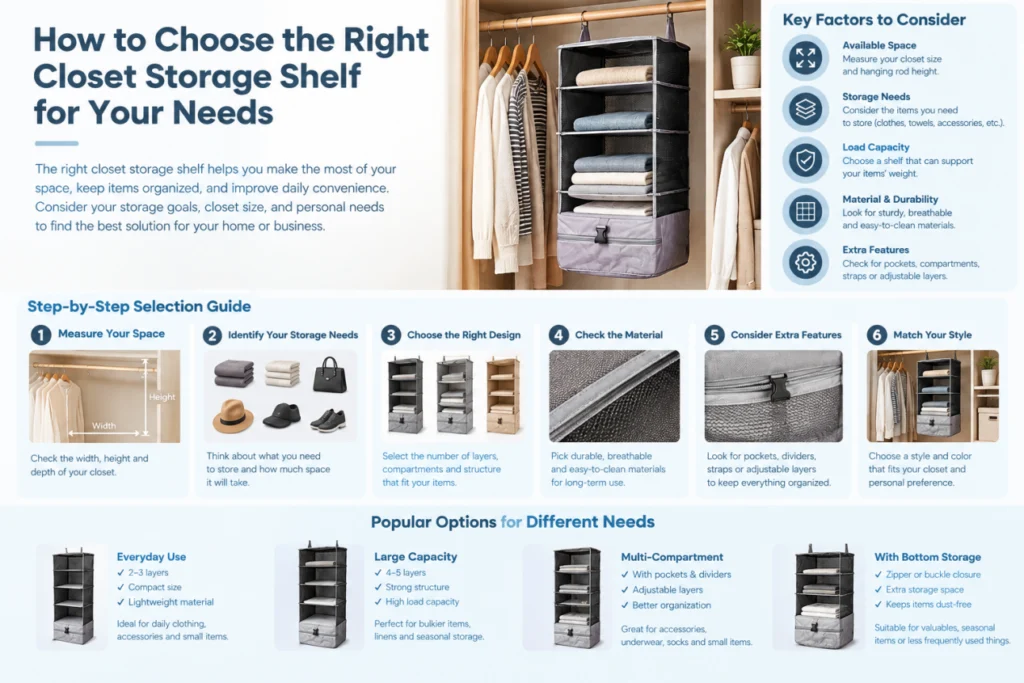
Selecting the appropriate wardrobe storage unit requires a comprehensive consideration of available space, storage requirements, material performance, structural design, load-bearing capacity, and procurement conditions. For everyday users, the primary focus should be on installation compatibility, categorized storage, and ease of access; for wholesalers, importers, and brand purchasers, additional considerations include product specifications, batch consistency, customization capabilities, packaging efficiency, and quality-control requirements.
Suspension storage racks improve the utilization of wardrobe space through multi-tiered compartments and a vertical hanging structure. When procuring, product dimensions, fabric, compartment configuration, and functional requirements should be determined based on the target market and actual intended use; samples, key specifications, and acceptance criteria should be confirmed prior to mass production to reduce selection deviations and batch quality risks.
If you are sourcing wardrobe organizers for wholesale, retail, or private-label projects, please provide the target product type, overall dimensions, compartment configuration, material preferences, load-bearing requirements, brand customization needs, and the estimated order quantity. Based on this information, wardrobe organizer manufacturers can further evaluate product specifications, material and structural options, sample validation requirements, and the feasibility of mass production.