
Large-capacity artificial Christmas tree storage bags represent a key product category for holiday product retailers, brand owners, and importers when developing Christmas tree storage solutions. Artificial Christmas trees typically consist of multiple sections that need to be disassembled, organized, and properly stored after the holiday season. If the storage bag is insufficient in size, lacks durable fabrics, or features handle structures that fail to accommodate actual handling needs, issues such as difficulty fitting tree sections, bag deformation, or inconvenient transport can easily arise.
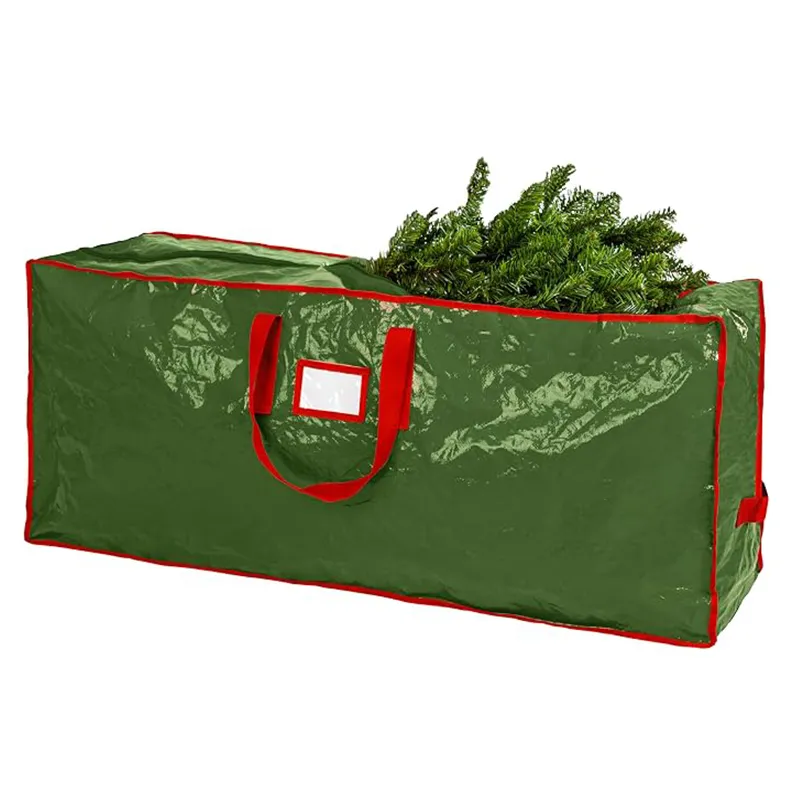
This thickened Christmas tree storage bag is crafted from durable waterproof fabric and features a spacious interior designed to accommodate disassembled artificial Christmas trees. Reinforced handles facilitate easy mobility, while the built-in label window allows for convenient identification and management of stored items. For buyers looking to develop private label products, attention must be paid not only to storage capacity, but also to details such as tree section dimensions, bag structure, fabric specifications, zippers, and handle connections.
A sensible approach to storing a Christmas tree does not involve cramming the branches as tightly as possible; rather, it entails disassembling and organizing the tree according to its structural design, followed by arranging the loading sequence based on the actual space inside the storage bag. This minimizes unnecessary compression and helps extend the service life of the storage bag.
Organizing the Christmas Tree Before Storage
After prolonged display, artificial Christmas trees may accumulate dust, decorations, and other debris between their branches and leaves. Before official bagging, it is recommended to clear the surrounding space and organize the tree structure.
First, remove all Christmas balls, ribbons, pendants, string lights, and tree-topper decorations. It is best to store decorations separately in ornament storage boxes to avoid crushing or scratching during disassembly and bagging.
If the tree features built-in lighting, disconnect the power supply according to the product manual and carefully organize the connection wires, ensuring that power components and cords are not pulled or strained during disassembly.
Next, inspect the surface of the branches for visible dust. If a damp cloth is required for cleaning, follow the care instructions for the tree material and ensure it is completely dry before placing it into the Christmas tree storage bag. For pre-lit models, confirm that relevant components meet the product’s required storage conditions.
Completing these preparations in advance reduces clutter during the bagging process and makes future retrieval and re-installation much easier.
Disassembling and Marking Tree Sections According to Structure
Most medium-to-large artificial Christmas trees consist of multiple sections, including a bottom, middle, and top. Connection methods may vary by tree style, so disassembly should prioritize the product manual, typically following the reverse order of assembly.
After disassembly, it is recommended to place different tree sections separately and record the length, quantity, and corresponding installation position of each section. For structurally similar sections, simple labels can be used to distinguish them, preventing confusion during the next assembly.
This process not only facilitates subsequent organization, but also helps buyers and storage bag manufacturers understand the actual space required for Christmas tree storage.
For example, artificial Christmas trees of the same height may exhibit significant differences in storage volume after disassembly due to varying crown widths, foliage densities, and section structures. Therefore, the dimensions of the storage bag cannot be determined solely based on the total height of the tree.
Moderately Compacting Branches to Avoid Over-Compression
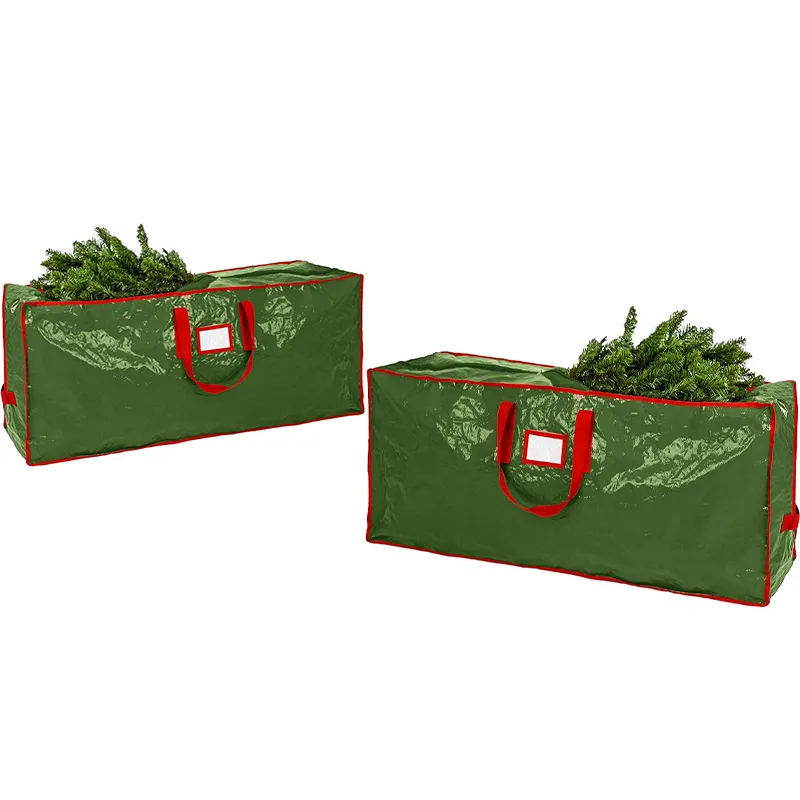
The branches and foliage of artificial Christmas trees are typically quite fluffy. If left fully expanded, the overall volume will be relatively large and inconvenient for placing into a storage bag.
During organization, gently gather the branches from the outer edges toward the trunk with your hands, bringing them close to the center. For branches with adjustable angles, carefully align them along their original range of motion rather than forcing them backward or twisting them.
If straps or ties are used, control the tightness so that the branches do not easily scatter while avoiding excessive compression. Foliage structures may vary among different tree types, and specific organization methods should follow the Christmas tree’s instruction manual.
Excessive compression does not necessarily yield better storage results. If branches remain under heavy pressure for long periods, they may require more time to regain their original shape once retrieved. Therefore, the focus of storage is to reasonably control volume rather than compress the tree to its absolute minimum size.
Confirming Storage Bag Capacity Based on Tree Section Dimensions
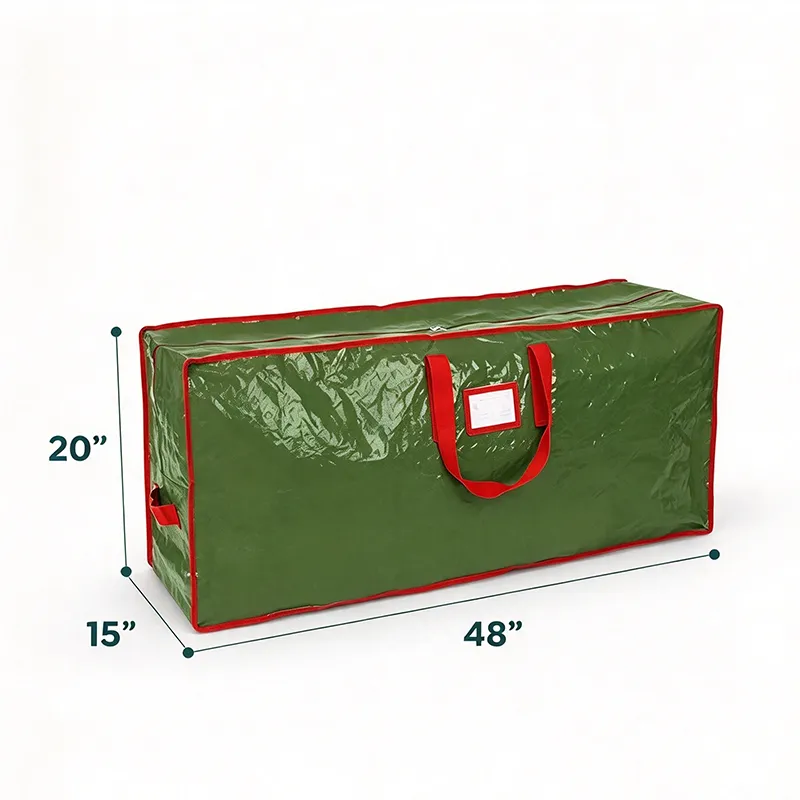
Whether a Christmas tree can be successfully placed into a storage bag primarily depends on whether the dimensions of the tree sections match the internal space of the bag.
When selecting a large-capacity Christmas tree storage bag, you should not rely solely on the applicable tree height indicated on the product; you must also measure each disassembled tree section. It is recommended to record the following information:
- Total height of the Christmas tree and the number of disassembled sections
- Maximum dimension of each tree section
- Maximum diameter or width of the foliage after gathering
- Total weight of the tree and related accessories
- Internal length, width, and height of the storage bag
- Opening dimensions and actual loading space
Among these, the maximum dimension of the tree sections determines whether the bag has sufficient internal length, while the maximum gathered diameter affects the bag’s width and loading capacity.
For instance, between two artificial Christmas trees of the same height, if one has fluffier foliage, its gathered diameter may be larger, placing higher demands on the internal space of the storage bag.
For B2B custom projects, buyers are advised to provide actual dimensions or reference samples of the target Christmas tree, allowing manufacturers to evaluate bag specifications based on real loading conditions. During confirmation, external dimensions and internal usable space should also be distinguished to avoid judging capacity solely by the product’s exterior appearance.
Arranging the Loading Sequence of Tree Sections
Once the size and opening of the Christmas tree storage bag are confirmed to accommodate the tree sections, the bagging process can begin.
Typically, longer or heavier tree sections can be placed in first, followed by other parts arranged according to the internal space of the bag. Adjacent tree sections can be interleaved or placed in reverse directions based on their actual shapes to prevent foliage from concentrating in one area and forming noticeable bulges.
During loading, pay attention to whether the tree sections press against each other and whether the bag exhibits localized over-stretching. For rigid tree trunks, connectors, and bottom stands, avoid letting their ends push directly against the bottom or walls of the bag to reduce wear and tear during transport.
If the bag deforms significantly after loading or if the opening cannot close naturally, readjust the position of the tree sections. Do not force contents together simply to increase the loading quantity.
For products requiring frequent handling, buyers should also inspect whether the internal space is reasonable and whether the bagging and retrieval processes are convenient using actual loaded samples.
Thickened Waterproof Fabric and Long-Term Storage Protection
Christmas trees typically require long storage periods; therefore, storage bags must not only offer sufficient capacity, but also feature fabric configurations suitable for the storage environment.
This Christmas tree storage bag adopts durable waterproof fabric, which helps minimize the impact of dust and moisture on artificial Christmas trees. Compared to temporarily using ordinary packaging materials, dedicated Christmas tree storage bags are easier to organize and transport while supporting subsequent reuse.
However, the specific performance of the fabric still relates to material specifications, coating treatments, and processing techniques. For custom projects, buyers should confirm fabric type, thickness or weight, color, and related quality requirements with the manufacturer, rather than accepting “waterproof fabric” as the sole acceptance criterion.
It should also be noted that waterproof fabric characteristics do not imply that zippers and seams are completely waterproof. If a project has explicit requirements for moisture or seepage resistance, testing methods and pass standards should be agreed upon during the prototyping stage and verified through finished products.
Additionally, ensure that the Christmas tree is completely dry before storage. Even with waterproof fabric, storing damp tree bodies in a sealed environment for extended periods is not recommended.
Reinforced Handles and Transport Structure
Once the Christmas tree is loaded into the storage bag, the overall weight may increase significantly, making the handle structure a direct factor in the product’s handling experience.
This product features reinforced, sturdy handles to facilitate user mobility and storage of the packed Christmas tree. For larger storage bags, handles must not only be evaluated for length and position, but also for stress distribution at the connection zones with the bag body.
If the bag contains longer or heavier tree sections, weight distribution may become uneven during transport. Therefore, during the sample confirmation stage, lifting and short-distance transport checks should be conducted according to expected load weights to observe whether handles, connection seams, and bag fabrics show loosening, unravelling, tearing, or noticeable deformation.
Testing should not be limited to empty bags. It is recommended to use actual tree bodies or equivalent loads agreed upon by both parties, with testing conditions and acceptance standards established in advance.
For larger custom projects, evaluations can also be made regarding whether shoulder straps, multiple handles, or rollers are needed based on the target market and usage methods. These are optional structural elements whose practical value should be confirmed through samples rather than adding production costs merely for the sake of extra features.
Label Windows Make Storage and Identification Easier
This Christmas tree storage bag is equipped with a built-in label window, enabling users to quickly identify items stored inside the bag.
For household users, information such as the Christmas tree height, style, or section details can be recorded on the label to facilitate future retrieval. For retailers, warehouse managers, and wholesalers, label windows also help distinguish products of different models, specifications, and batches.
From a product development perspective, although the label window is not a primary load-bearing structure, its position, size, and user convenience still warrant attention.
Buyers can check during the prototyping stage whether labels are easy to insert and remove, whether the window is clear, whether the position is convenient for viewing, and whether it is prone to loosening or damage during use.
For private label projects, the label window’s practical usage can be planned alongside product packaging and brand information. However, caution should be exercised not to confuse the label window with additional internal storage pockets, as their functions are distinct.
Sample Verification and Quality Control for Christmas Tree Storage Bags
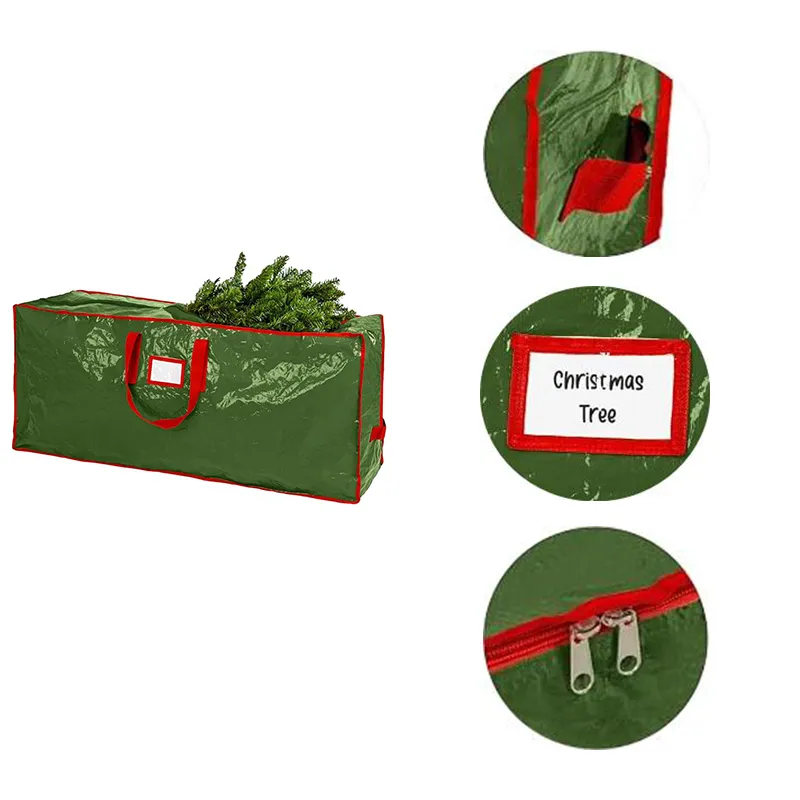
For brand owners, importers, and wholesale buyers, sample confirmation for Christmas tree storage bags cannot rely on visual inspection alone. The crucial step is placing the target Christmas tree into the bag to verify product performance under actual usage conditions.
It is recommended to focus on inspecting the following items during the prototyping stage:
For any issues discovered, specific locations, manifestations, and adjustment requirements should be recorded, modified by the manufacturer, and re-verified.
Once samples are approved, it is recommended to retain the confirmed samples and written specifications—covering fabric, dimensions, color, zippers, handles, label windows, and packaging requirements—as the basis for subsequent mass production and quality inspection.
Procurement and Production Requirements for Custom Christmas Tree Storage Bags
For retail private labels, holiday goods importers, and wholesale distributors, developing a Christmas tree storage bag requires more than just providing a reference picture.
Buyers should provide the target Christmas tree’s height, number of disassembled sections, length of each section, maximum gathered diameter, overall weight, and expected handling method wherever possible. Simultaneously, internal bag dimensions, fabric specifications, handle structures, label windows, logos, colors, packaging methods, and expected purchase quantities must be clearly defined.
This information helps manufacturers evaluate material consumption, bag structure, and production feasibility.
If clients wish to develop private label products, logo files, printing positions, label content, and outer packaging design can be further confirmed. For thickened Christmas tree storage bags, fabric specifications and handle connection methods especially require confirmation during the sample stage.
Quotations should unify materials, dimensions, structures, custom elements, and packaging requirements to prevent different suppliers from quoting based on disparate configurations, which would prevent buyers from accurately comparing costs.
Prior to mass production, confirmed samples and key specifications should serve as the production baseline. If subsequent material changes, dimension adjustments, or structural modifications to handles and label windows become necessary, communicate in advance to obtain confirmation, performing sample re-verification if required.
Frequently Asked Questions
Can a Christmas tree be put directly into a storage bag?
For segmented artificial Christmas trees, it is recommended to first disassemble them into sections, organize the branches, and place them into the storage bag sequentially. This makes volume control, transport, and re-installation much easier.
Does a Christmas tree need to be compressed very tightly to fit into the bag?
Excessive compression is not recommended. Branches can be gently gathered along their original range of motion, but forced backward bending or prolonged heavy squeezing should be avoided to prevent hindering the recovery of the tree’s original shape.
What dimensions should be paid attention to for large-capacity Christmas tree storage bags?
In addition to the total height of the Christmas tree, attention should be paid to disassembled section lengths, maximum gathered diameters, internal bag space, and opening dimensions. All these factors affect actual loading performance.
Can a waterproof Christmas tree storage bag completely prevent moisture?
Waterproof fabrics help minimize moisture impact, but entry paths may still exist around zippers and seams. Ensure the tree is dry before long-term storage and conduct finished product testing according to actual waterproof requirements.
What is the purpose of the label window on a Christmas tree storage bag?
The label window facilitates recording and identifying the Christmas tree model, size, or other information stored inside the bag, aiding in household organization and warehouse management.
Making Storage Easier Starts with Product Structure
Christmas tree storage requires not only sensible disassembly and bagging methods, but also appropriate storage bag structures. Large-capacity bag designs provide ample storage room, thickened waterproof fabrics help reduce dust and moisture impact, reinforced handles simplify transport, and label windows make item identification effortless.
For brand owners, retailers, and importers, developing a practical Christmas tree storage bag begins with the actual dimensions and weight of the target tree, followed by confirming fabric, bag structure, handles, label windows, and packaging configurations.
From practical loading verification to mass production, integrating every key detail into confirmed samples and product specifications ensures that Christmas tree storage bags truly meet long-term storage and market sales demands.