
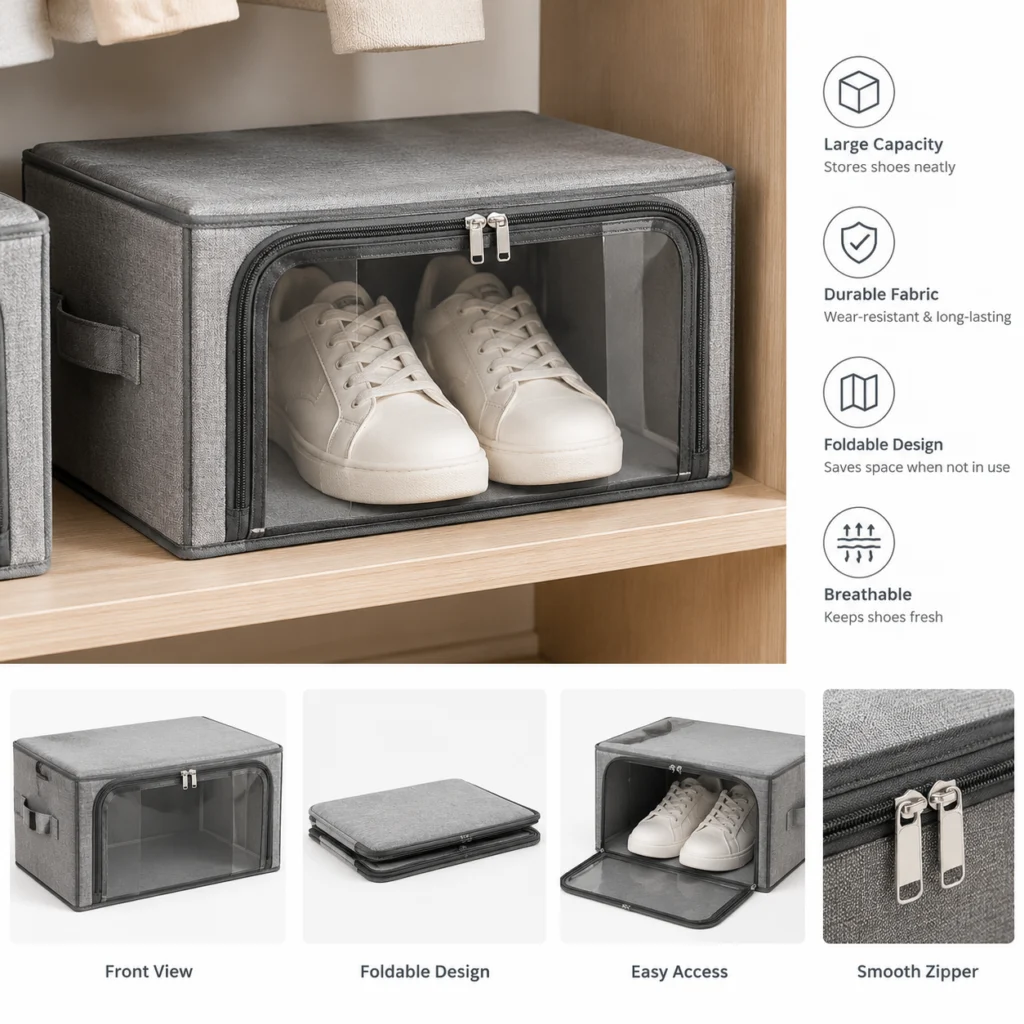
First determine the shoe style, then select the shoe box dimensions
Customizable foldable fabric shoe boxes cannot be designed using standard dimensions directly. There are significant size differences among athletic shoes, casual shoes, high-top shoes, and ankle boots; therefore, looking only at the shoe size is not sufficient.
Standard athletic shoes and casual shoes
First determine your target shoe size, then select a few representative shoe models and measure them in person. The interior of the shoe box should not be made too tight; otherwise, although the shoes will fit inside, removing them will be quite difficult. When designing the box, it is best to leave adequate space and test it with actual footwear.
High-top shoes and boots
For this type of footwear, particular attention should be paid to the interior height. Sometimes the length and width may be appropriate, but if the shoe upper is too high, it will press against the transparent closure when the foot is placed inside, hindering closure. If a product needs to fit a variety of shoe styles, it is advisable to design different sizes based on the footwear styles and size range of the target market; there is no need to insist on a single specification that suits every shoe.
Why External Dimensions Do Not Guarantee Actual Capacity
This is a common issue when procuring fabric shoe boxes.
While plastic boxes have easily determinable internal spaces, fabric products are affected by fabric thickness, seam allowances, hems, and structural connections.
For example, when a supplier states that a shoe box has a certain dimension, that figure may refer to the external dimensions of the unfolded product, whereas clients actually care about:
How much usable space is available inside for shoes
Therefore, during customization, it is best to confirm several dimensions separately: external product dimensions, internal effective space, opening dimensions, and the position and size of any dividers. Particularly for footwear storage products, internal dimensions directly relate to whether the final product can accommodate the target shoe types.
If clients already have explicit shoe types, providing actual shoes or detailed dimensions to the manufacturer is much more effective than simply telling the supplier “an adult shoe box is needed” to obtain an accurate design solution.
Fabric Product Dimensions Must Also Account for Tolerances
Unlike rigid plastic boxes, fabric shoe box dimensions are easily influenced by fabric softness, cutting accuracy, sewing techniques, and folding methods. Thus, determining product specifications requires defining allowable deviations for critical dimensions.
There is no universal standard for dimensional tolerances applicable to all fabric shoe boxes; they should be reasonably established based on product size, material properties, structural design, and practical use. It is recommended to complete samples first, then determine appropriate tolerance ranges through actual measurement and usage testing.
During the sample confirmation stage, prioritize recording external dimensions, internal effective length, width, and height, opening dimensions, and key compartment sizes, while standardizing measurement states and methods. For products tailored to specific shoe types, test placing shoes in, taking them out, and closing the lid to ensure internal space meets operational needs.
Ultimately, critical dimensions and their allowable tolerances should be explicitly written into product specification documents to serve as the basis for mass production and quality inspection.
Transparent Lids Are Not Just for Visibility
A direct benefit of using a transparent lid on a foldable fabric shoe box is seeing which shoes are inside without opening the box.
For home organization, this reduces time spent searching for shoes; for retail and inventory management, it facilitates quick identification of different shoe styles.
However, from a product development perspective, transparent lids also constitute a structural element requiring separate consideration.
Choosing Transparent Materials
When procuring, avoid simply telling suppliers “just make it transparent.” At minimum, confirm the specific specifications of the transparent material and whether it suits the product’s folding, opening, and closing methods. Pay attention to:
- Transparency effect
- Material thickness
- Softness
- Condition after folding
- Surface susceptibility to visible creases
- Ease of processing when connecting to the fabric body
Different materials perform differently in actual production. Especially for shoe boxes requiring frequent folding, transparent materials should not be judged solely on static appearance.
A transparent sheet might look completely flat right after production, but its performance may change after folding, unfolding, and repeated opening and closing. Therefore, such issues are best evaluated through hands-on sample operation.
The Connection Between the Transparent Lid and Fabric Deserves Close Inspection
Transparent materials and fabrics possess different characteristics.
Fabrics bend and fold, whereas transparent sheets behave differently. Once both materials are joined, tension generated during opening and closing is unevenly distributed. Consequently, the joint where the transparent lid meets the main body is typically a focal point during sampling.
Verification of transparent lids should be determined based on expected usage frequency and opening/closing structure. During sample testing, perform operations according to predetermined open-close cycles, checking whether connections between the transparent sheet and fabric show unraveling, cracking, noticeable loosening, or deformation affecting normal operation. Simultaneously, observe whether transparent areas develop visible creases affecting appearance or utility.
For repeat purchases or projects with strict lifespan requirements, establishing test cycles, inspection items, and acceptance criteria during the sampling stage is recommended, alongside recording conditions before and after testing.
Do Shoe Boxes Actually Need Dividers
Dividers affect both internal box space and material/production costs. The necessity of dividers should be determined by product positioning and actual storage demands, rather than merely to enhance perceived value.
- Shoe boxes with dividers suit scenarios requiring separation of left and right shoes, enhanced internal organization, or classified storage.
- Shoe boxes without dividers feature simpler structures, more flexible internal space utilization, and help reduce material consumption and sewing procedures, making them better suited for products emphasizing storage capacity and cost control.
What to Note in Divider Design
If dividers are deemed necessary, design and sample them together with the main shoe box body. Divider width, height, and fixing methods all influence internal effective space, shoe retrieval, and overall folding performance. For detachable dividers, check whether assembly and disassembly are convenient, and whether stability is maintained after repeated installation.
Prior to finalizing a plan, clarify the primary purpose of the dividers, then verify their position, size, and fixing method against target shoe types to ensure the box functions properly for storage, retrieval, and folding with dividers added.
How Does the Foldable Structure Impact Transportation and Production?
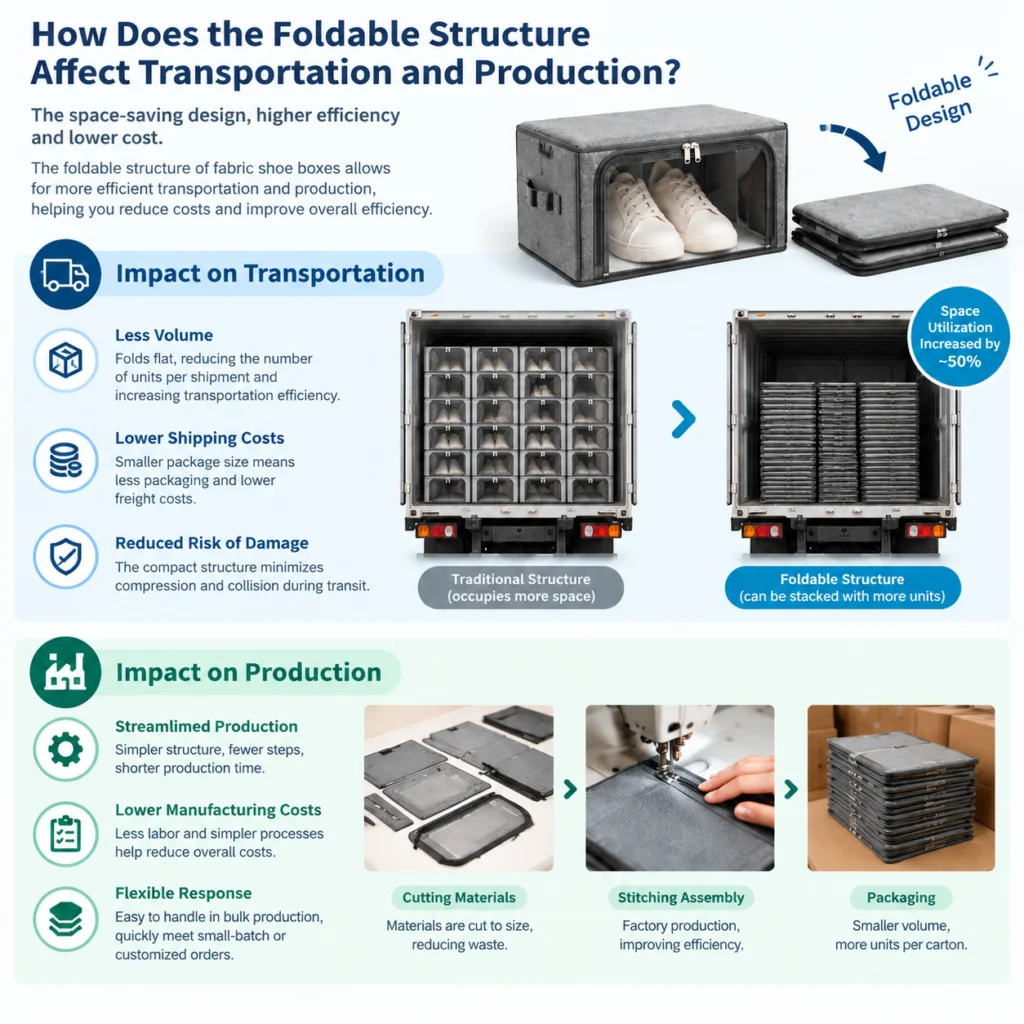
Foldability is a highly practical feature of fabric shoe boxes.
For bulk procurement, the ability of shoe boxes to fold during transit and warehousing typically means reduced space consumption per unit.
Yet “foldable” does not mean simpler structures are always better.
Shoe boxes must transition between two states: folded during shipping, and restored to regular box form during use. This demands a balance among product fabrics, sewing methods, and structural design.
Shape Recovery After Unfolding
This is an easily manageable check during sample confirmation.
Fully unfold the shoe box, place a pair of actual shoes inside, and observe whether the box body maintains its regular shape. Fold it back up, then unfold it again. Focus heavily on several areas:
- Four corners
- Bottom
- Transparent lid
- Dividers
- Folding joints
-
Seam connections
If a product requires extensive manual effort to regain its shape after unfolding, the user experience for consumers may fall short. If the product positioning involves frequent folding and storage, repeat folding verification can be added based on actual usage requirements.
What Materials Should Be Chosen for Fabric Shoe Boxes?
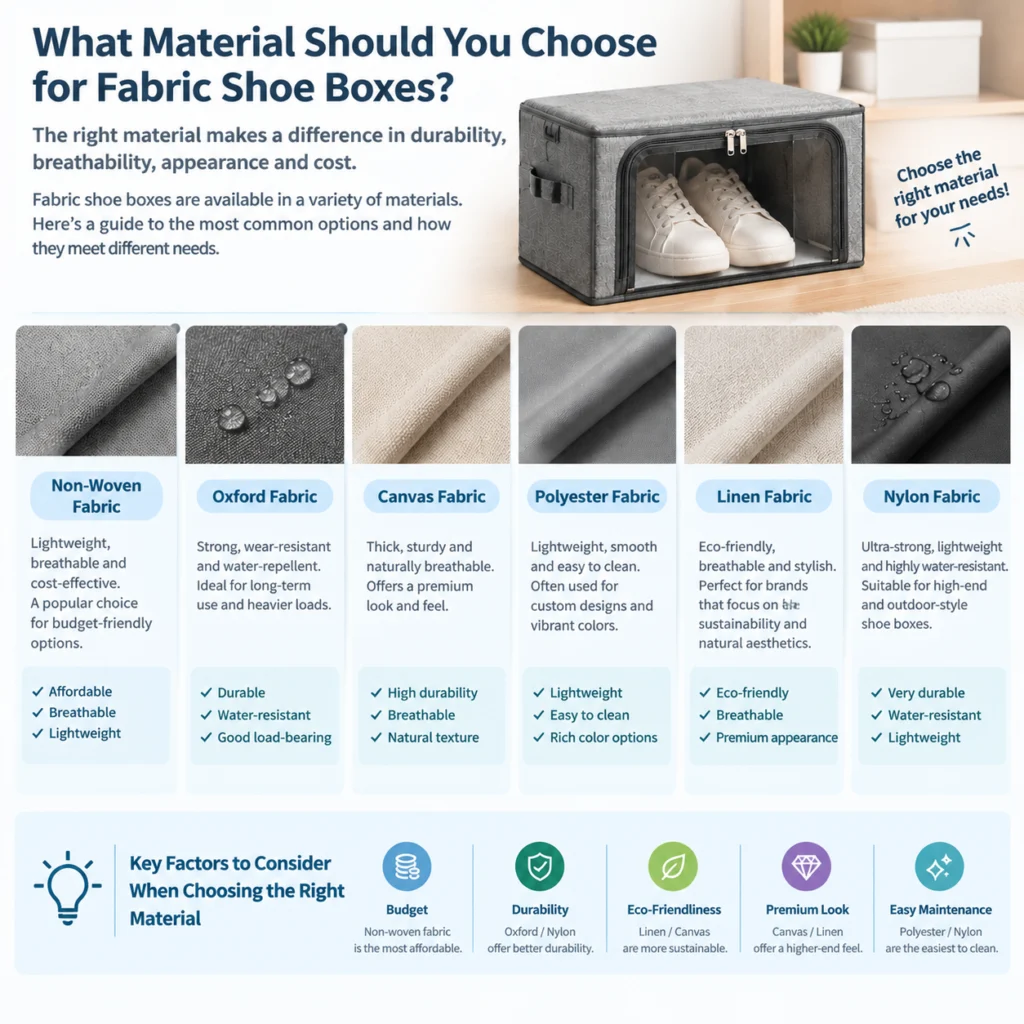
Material selection for foldable fabric shoe boxes should comprehensively factor in product positioning, application scenarios, structural design, and target costs. Common materials include polyester fabrics, non-woven fabrics, and localized mesh or transparent materials.
Procurement Advice: If a product emphasizes brand customization, prioritize evaluating polyester fabrics; if lightweight design and cost control are key, consider non-woven fabrics; if breathability or visibility is needed, incorporate local mesh or transparent materials. For bulk procurement, confirm material specifications, joining techniques, and critical stress zones during the sampling stage, then determine final solutions based on sample test results.
Key Areas Worthy of Structural Verification
Fabric shoe boxes do not require complex structural testing across every single component. For buyers and product developers, identifying critical areas affecting structural stability, daily user experience, and lifespan—and establishing validation plans based on design traits and usage scenarios—is far more crucial.
Structural verification should follow product designs during the sampling stage using tailored inspection plans. For products loading shoes, check box stability and practical performance against target shoe types; for structures subject to repeated opening/closing or folding, define operational methods, verification counts, and inspection criteria.
Test results should document discovered issues, corresponding locations, potential causes, and improvement measures. If structural or process adjustments occur, re-verify affected functions and incorporate finalized schemes into sample and mass production specification documents.
What to Check During Sample Confirmation
In B2B bulk procurement, sample confirmation is a vital link to ensure products meet requirements. Buyers should meticulously verify product dimensions, internal effective space, fabrics, transparent lids, dividers, folding structures, logos, sewing details, and packaging methods, confirming performance through actual shoe insertion, retrieval, and folding tests.
For custom shoe boxes, material specifications, critical dimensions, and craftsmanship requirements must also be specified to guarantee samples match expectations, using approved samples as the basis for mass production.
How to Ensure Mass Production Consistency with Samples
During mass production, buyers should inspect materials, critical dimensions, sewing processes, colors, logos, and product functions against approved samples and specification files.
Concurrently, establish a clear confirmation process for material, structural, and process changes with suppliers to prevent unapproved adjustments from impacting quality. For long-term purchasing projects, monitor consistency across production batches to minimize quality variance, rework, and delivery risks.
Do Not Compare Suppliers Solely on Unit Price
Quotations from different shoe box suppliers always vary; buyers should avoid focusing solely on unit price without verifying matching product configurations. For instance, differences in fabric specs, transparent lid materials, divider setups, and packaging methods can all influence final pricing.
Therefore, inquiries should unify key requirements including product dimensions, internal space, primary materials, transparent lids, dividers, logos, packaging, MOQ, purchasing quantity, and lead times.
Comparing prices solely on the foundation of consistent product specifications and purchasing conditions enables a more accurate evaluation of supplier quotes and comprehensive procurement costs.
What to Confirm with Manufacturers for Customization
For brand customization or long-term procurement projects, beyond dimensions and pricing, confirm these key details in advance:
- Dimensions: Which shoe types and sizes are accommodated? Must multiple sizes be covered?
- Materials: What specifications govern the main fabric and transparent material?
- Structure: Are dividers needed? What is the folding method?
- Branding: How are logo placement and production techniques determined?
- Packaging: Is individual packaging or multi-unit boxing used? What are the folded package dimensions?
- Production: How are samples confirmed? How does mass production ensure consistency with approved samples?
Clarifying these requirements ahead of time helps cut communication costs while reducing mass production variance and delivery risks.
From Product Design to Mass Production: Ensuring Fabric Shoe Boxes Meet Procurement Needs
Selecting a suitable foldable fabric shoe box requires looking beyond whether it “fits shoes.” One must consider storage capacity alongside size adaptation, transparent lids, dividers, folding structures, and mass production stability.
For B2B procurement projects, establishing internal space based on target shoe types first, followed by selecting appropriate materials and structures, and validating shoe retrieval, folding effects, and critical joints via samples is highly recommended. Entering mass production requires defining dimensions, materials, structures, and appearance standards to ensure compliance.
For brands, importers, and wholesalers, thoroughly confirming these details early helps mitigate subsequent modifications, rework, and delivery risks. An ideal fabric shoe box must not only feature practical design and easy transportability, but also meet market demand and possess stable batch production capabilities.