
When traveling, people often need to bring rings, necklaces, earrings, and bracelets together. Placing them all in an ordinary pouch can cause different pieces of jewelry to become mixed together. Necklaces may tangle, and small accessories can be difficult to find quickly. For frequent travelers, business travelers, and anyone who carries multiple types of jewelry, an organizer that keeps items sorted and can be easily unfolded and rolled up is a more practical option.
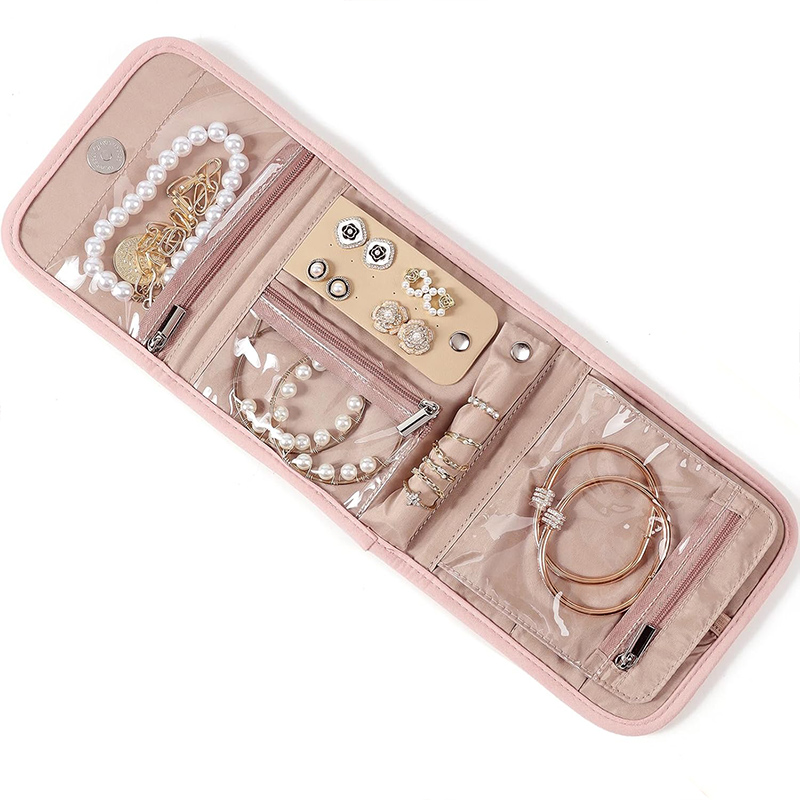
The quilted microfiber travel jewelry roll is designed to meet these needs. It combines organized jewelry storage with a roll-up format, using different interior sections to hold rings, necklaces, earrings, and other small accessories. The organizer can be unfolded for easy access and rolled up and secured after use, helping reduce the space it takes up during travel.
For jewelry brands, travel accessory brands, gift suppliers, and wholesale buyers, a travel jewelry roll is more than a portable storage product. Its development also involves several factors, including microfiber fabric, quilted padding, interior layout, closure construction, and packaging. A well-planned design affects the user experience and helps maintain consistency during sampling and mass production.
What Storage Problems Can a Travel Jewelry Roll Solve?
The main value of a travel jewelry roll is not simply putting jewelry in one place. Its interior structure gives different types of accessories their own designated storage areas.
Keep Different Types of Jewelry Separate
Rings, earrings, necklaces, and bracelets vary in shape and size. When they are stored together in one compartment, they can come into contact during travel and become difficult to locate quickly.
Jewelry can be organized by type using retaining straps, individual pockets, or designated compartments. For example, necklaces can be placed in a dedicated section, rings and earrings can be stored in their corresponding areas, and small accessories can be kept in a separate pocket.
For buyers, adding more compartments is not necessarily better. First identify the types and quantities of jewelry that target users typically carry, then determine the compartment configuration to avoid inefficient use of space.
Unfold for Use, Roll Up for Travel
Unlike a conventional flat jewelry pouch, a roll-up jewelry organizer can switch between an open, unfolded state and a compact, rolled-up state.
When in use, the organizer can be unfolded to reveal its different storage sections, making jewelry easy to place and remove. When it is time to travel, it can be rolled up according to its construction and secured using the specified closure.
However, a more compact roll-up design is not always better. The thickness of the rolled organizer increases when more jewelry is stored inside. Product development should therefore consider the unfolded capacity, actual load, and overall dimensions after rolling.
Buyers should not assess portability based only on the empty product. The roll-up result should also be checked after loading it with the intended jewelry.
Key Design Considerations for Quilted Microfiber Fabric
Fabric is an important component of a quilted microfiber travel jewelry roll. It affects not only the product’s appearance and feel, but also its thickness, softness, and roll-up performance.
Confirming Microfiber Fabric Specifications
Microfiber fabric often has a fine, soft surface and can be used for either the outer layer or the lining of a jewelry organizer. During procurement, confirm the actual fabric specifications, including thickness, softness, color, surface texture, and material stability.
For products aimed at jewelry brands that place a strong emphasis on appearance, fabric color, surface smoothness, and overall texture may be key considerations. For the travel accessories market, buyers should also consider how the fabric performs after repeated unfolding, rolling, and everyday handling.
It is important to note that the term “microfiber” does not mean all fabrics offer the same level of protection. Whether a fabric is suitable for direct contact with jewelry should be evaluated based on the specific material, lining configuration, and intended use. The material name alone is not enough to determine suitability.
How Quilting Affects Thickness and Roll-Up Performance
Quilting generally joins the fabric to an inner padding layer with stitching to create a regular textured pattern. This can add visual dimension to the product, while also affecting the pouch’s thickness and softness.
For a travel jewelry roll, the quilted construction needs to balance appearance with roll-up performance. If the padding is too thick, the rolled product may take up more space. If the construction is too soft, the overall shape when unfolded should be assessed to ensure it meets the design requirements.
During procurement, confirm the quilting pattern, stitch spacing, padding thickness, and edge finishing. At the sampling stage, check that the stitching is even and look for skipped stitches, broken threads, puckering, or uneven areas.
If the product has a specific roll-up size requirement, test the quilted construction with the organizer loaded with jewelry. This helps ensure that the fabric and padding configuration do not compromise portability.
Coordinate the Fabric with Interior Contact Areas
The interior of a jewelry roll may include retaining straps, pockets, divided sections, and other storage features. Combining different materials can affect the product’s thickness, softness, and overall usability.
If the outer fabric and lining are different, check that the joining areas are smooth and that interior components do not fold over or shift easily. In areas that come into direct contact with jewelry, also check for rough surfaces, loose threads, or other details that could affect the jewelry’s finish.
Buyers should confirm the material combination based on the target jewelry types and product positioning, then inspect the actual result through samples rather than deciding on the final configuration based only on fabric names.
Interior Layout Determines the Practicality of a Jewelry Roll
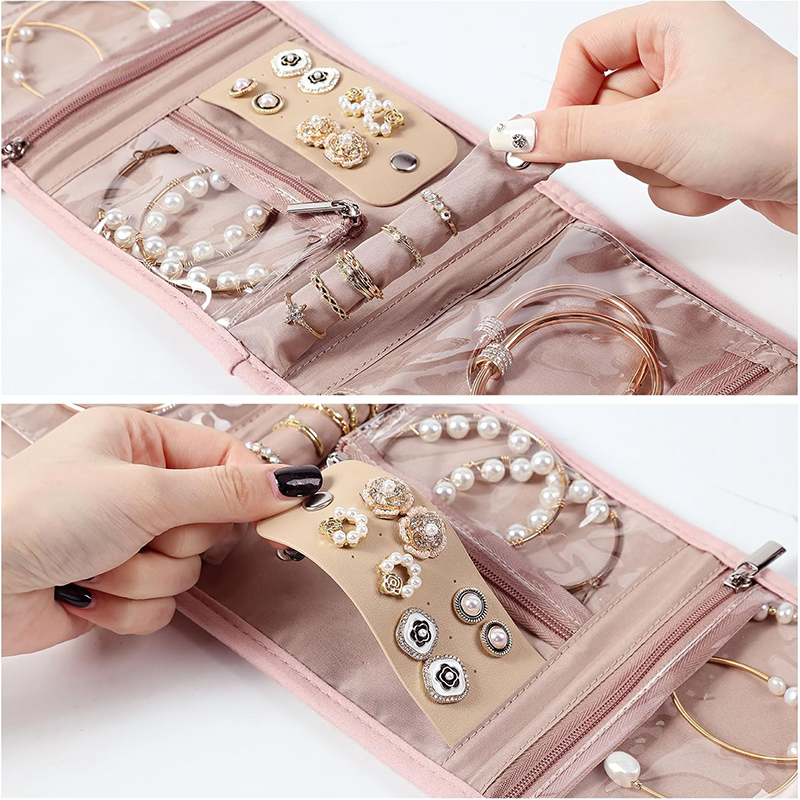
The key to a travel jewelry roll is not simply whether it can be rolled up, but whether it can store different types of jewelry effectively when unfolded. The interior layout should be designed around the items that will actually be stored, while also accounting for the space and structure of the rolled product.
Necklace Section: Consider Retention and Spacing
Necklaces need particular attention when organizing jewelry for travel. Their chains are often long and may tangle or knot if stored together with other accessories.
A travel necklace organizer can therefore include retaining points or separate storage sections to help keep necklaces orderly after they are placed inside.
During procurement, confirm the available space based on the length of the target necklaces, chain thickness, and pendant dimensions. If the product is intended to hold multiple necklaces, consider the spacing between storage positions to prevent the chains from being crowded together.
For styles with large pendants, check whether the storage section can accommodate the pendant and whether it may be pressed by other interior components after the organizer is rolled up. Retaining points should also be easy to use. The design should account for removal as well as placement.
Ring and Earring Sections: Consider Sizing and Accessibility
Rings and earrings are generally small and can be stored in dedicated retaining positions or categorized sections.
The ring section should account for ring width, quantity, and placement. Slots that are too narrow may make rings difficult to insert or remove, while insufficient spacing may allow different rings to touch one another.
Earrings come in a wider variety of styles, including studs, hoops, and long drop earrings. Each style requires a different amount of storage space, so the entire earring section should not be designed around the dimensions of standard studs alone.
For a customized travel jewelry roll, first identify the types of jewelry that the target users commonly carry. Then determine the number, dimensions, and arrangement of the ring and earring sections. During sampling, test the organizer with different jewelry styles to confirm that every section works as intended.
Zippered Pocket: For Small Accessories
Some jewelry rolls include a separate zippered pocket for earring backs, spare clasps, or other small items that are not suitable for the designated retaining sections.
The size of the zippered pocket should be based on the items it is intended to hold. A pocket that is too small can make items difficult to access, while one that is too large may take up space needed by other jewelry sections.
Also check whether the zipper is easy to operate and whether items can come into contact with other jewelry inside when the pocket is open. For products designed to remain compact when rolled, assess how much thickness the pocket adds when filled to ensure that it does not interfere with closure.
Balance Interior Capacity with Rolled Dimensions
This is an easily overlooked point when developing a travel jewelry roll.
Adding storage pockets and retaining sections generally uses more interior space and may increase the overall thickness of the rolled product. If the design focuses only on the number of compartments, the organizer may become too bulky to carry comfortably.
Buyers should therefore identify the types and quantities of target jewelry before planning the interior layout. For a product mainly intended for rings and earrings, a compact design may be preferable. If it needs to hold several necklaces, bracelets, and larger accessories at the same time, the unfolded dimensions may need to be increased.
The final sample should be loaded with actual jewelry to check the usable space when unfolded, possible contact between different pieces, and the carrying condition after rolling. Capacity should not be judged from a flat design drawing alone.
Different Sales Markets Require Different Product Configurations
Travel jewelry rolls can be sold through several channels, but target users and usage requirements vary by channel. B2B buyers should determine the fabric, interior layout, and appearance according to their market positioning.
Travel Accessories Market: Focus on Portability and Capacity
Travel accessory brands are generally more concerned with the organizer’s storage capacity when unfolded and whether it can easily fit into a suitcase or personal bag when rolled up.
For these products, confirm the unfolded dimensions, rolled thickness, closure method, and number of interior sections. For frequent business travelers, ease of use and quick access to commonly worn jewelry are also important design considerations.
Jewelry Brands: Focus on Appearance and Brand Identity
Jewelry brands generally want their packaging and accessories to align with their overall brand image.
During procurement, the design can be developed around microfiber color, quilting pattern, interior materials, and logo placement. Different colors or interior layouts can also be developed for different jewelry collections based on their product characteristics.
If the organizer is intended as a complimentary gift with a jewelry purchase, consider the dimensional relationship between the jewelry roll and the outer gift box.
Gift Market: Focus on Overall Presentation
In addition to storage functionality, gift products need to consider appearance and packaging presentation.
Fabric colors and logo designs can be selected to suit a holiday, anniversary, or brand theme. If the product will be packaged with a gift box, instruction card, or other accessories, determine the combination early in development to avoid having to adjust the packaging dimensions after the product is completed.
Everyday Jewelry Organization: Focus on Sorting and Ease of Use
For everyday use, the product does not necessarily need a very large capacity. More important considerations are whether frequently used jewelry can be organized effectively, whether the contents are easy to see when unfolded, and whether the organizer is convenient to store when rolled up.
The design should therefore prioritize practical interior sections and avoid adding too many pockets or features that users are unlikely to need.
Specifications to Confirm When Sourcing Travel Jewelry Rolls for B2B Orders
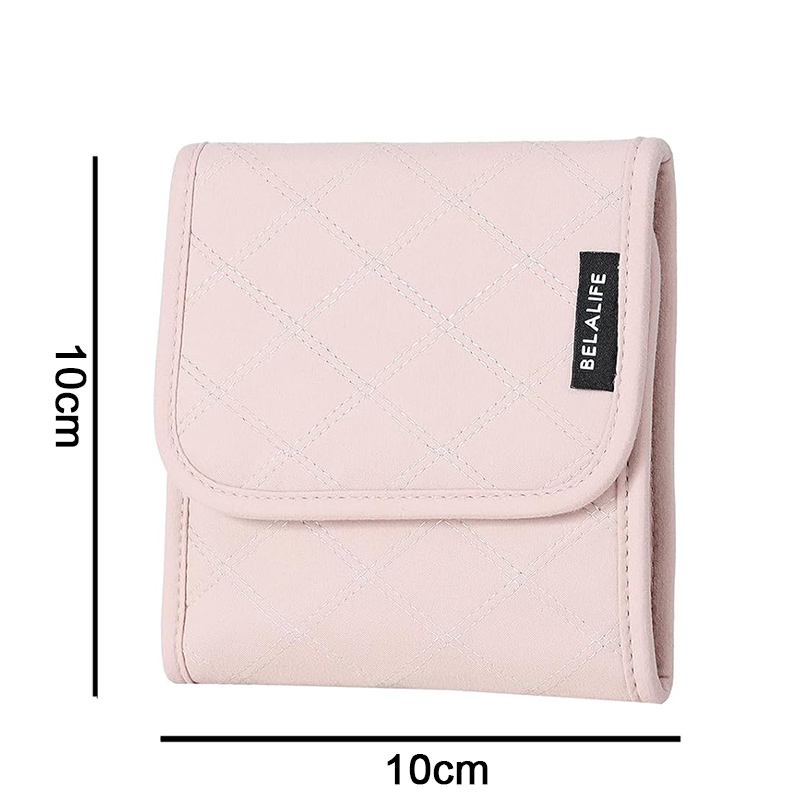
For brands, wholesalers, importers, and retailers, product requirements should be translated into clear specifications before procurement. A reference image alone is usually not enough to determine the final product construction.
The following details should be confirmed:
| Procurement Item | Details to Confirm |
| Unfolded Dimensions | Length, width, and measurement method when the product is fully unfolded |
| Rolled Dimensions | Length, diameter, or thickness before and after loading |
| Outer Fabric | Microfiber fabric specifications, color, and surface requirements |
| Quilted Construction | Quilting pattern, stitching, spacing, and padding configuration |
| Interior Layout | Number, dimensions, and positions of necklace, ring, earring, and zippered-pocket sections |
| Retaining Structure | Necklace retention method, interior retaining straps, and other storage features |
| Closure Method | Rolling direction, securing method, and condition after closure |
| Brand Customization | Logo application method, position, size, and color |
| Packaging Requirements | Individual packaging, labels, outer carton dimensions, and packing quantity |
If the buyer has not finalized the dimensions, they can first provide the dimensions and quantities of the target jewelry, along with the intended storage scenarios. The supplier can then assess the interior construction based on the actual requirements.
For customized travel jewelry rolls, also confirm whether multiple colors, sizes, or interior layouts are required. Each configuration should have its own specification to prevent confusion between styles during production.
The same material, dimensions, and construction requirements should also be used when requesting quotations. Even when suppliers offer microfiber jewelry rolls, differences in fabric specifications, interior features, quilted construction, and packaging will affect product cost. Price comparisons are more meaningful when the main material, construction, and packaging requirements are consistent.
Sample Approval and Quality Checks for Mass Production
For B2B orders, sample approval involves more than checking the product’s appearance. It should also verify actual storage performance, the rolled-up condition, and packaging compatibility. For quilted microfiber travel jewelry rolls with multiple interior features, testing with the intended jewelry is especially important.
Check the Unfolded Dimensions and Roll-Up Performance
First, verify that the sample’s unfolded dimensions meet the agreed specifications. Then roll it up according to the intended method and check whether it comes loose easily after closure and whether the overall shape is neat.
If the product needs to fit into a travel bag or gift box of a specific size, measure the actual rolled dimensions to confirm that they meet the packaging and carrying requirements.
Test the Interior Layout with Actual Jewelry
Prepare representative rings, necklaces, earrings, and bracelets commonly found in the target market for a loading test.
Check whether each section can accommodate the intended jewelry, whether necklace retainers are easy to use, whether rings and earrings can be inserted and removed easily, and whether the zippered pocket has sufficient space.
After loading the organizer, roll it up and observe whether different pieces of jewelry press against one another. Check for excessive bulging, shifted interior components, or any difficulty closing the product properly.
Inspect the Quilting, Stitching, and Fabric
The appearance quality of a quilted microfiber jewelry roll is closely related to its stitching and fabric finishing.
During sample inspection, check whether the quilting pattern is even, the stitching is continuous, the edges are neat, and the fabric is free from stains, noticeable color differences, and other visual defects.
Also inspect the interior pockets, retaining straps, and edge seams to confirm that all storage sections meet the approved design requirements.
Confirm the Brand Logo and Packaging
If the product requires logo customization, check the logo’s position, size, color, and production quality. Different fabrics and processes may produce different visual results, so the approved sample should be used as the reference for subsequent production.
For packaging, confirm the individual package dimensions after the product is rolled up, label information, and outer carton configuration. If the order includes multiple colors or styles, also specify the packing quantity and identification method for each product.
Establish Mass-Production Specifications and Acceptance Standards
After sample approval, document the key requirements in written specifications. These should include fabric, color, unfolded dimensions, rolled dimensions, interior layout, quilted construction, closure method, logo, and packaging requirements.
During mass production, pay particular attention to dimensional consistency, sewing quality, the position of interior components, and overall appearance. If the material, padding, or interior layout changes, reassess how the change may affect product thickness, roll-up performance, and the storage experience.
Using the approved sample and written specifications as shared references can reduce misunderstandings between the buyer and manufacturer and help maintain consistency across repeat orders.
Frequently Asked Questions
What types of jewelry can a travel jewelry roll hold?
Depending on its interior layout, it can hold rings, necklaces, earrings, bracelets, and other small accessories. The actual capacity depends on the product dimensions and the configuration of its storage sections.
What are the characteristics of a microfiber jewelry roll?
Microfiber fabric generally has a fine, soft feel. Its actual appearance and performance should be confirmed based on the fabric specifications and lining construction.
Does quilting make the product thicker?
Product thickness is affected by the fabric, padding, and quilted construction. During procurement, confirm both the quilting effect and the overall dimensions after the organizer is rolled up.
Can the interior layout of a jewelry roll be customized?
Yes. The configuration of necklace retainers, ring positions, earring sections, and zippered pockets can be discussed according to the types, quantities, and dimensions of the jewelry.
What should be confirmed before placing a bulk order?
Key items include unfolded dimensions, rolled dimensions, fabric, quilted construction, interior layout, closure method, logo, and packaging requirements. These should be verified through an actual loading test using a sample.
Design Storage Features Around Real Use
A practical quilted travel jewelry roll is more than a pouch that can be rolled up to hold jewelry. It should provide suitable storage positions for different types of accessories while balancing ease of use when unfolded, compactness when rolled, and portability.
For B2B sourcing projects, start with the dimensions and quantities of the target jewelry to determine the fabric, quilted construction, interior layout, and closure method. Then use samples to verify actual performance. Recording the approved sample and key specifications in the mass-production requirements helps keep product design, purchasing needs, and bulk production aligned.