
A good shoe bag should fit the shoes, be easy to carry, and suit everyday use. Whether for travel, home storage, retail packaging, hotel supplies, or sneaker storage, the material, size, and closure all affect its practicality.
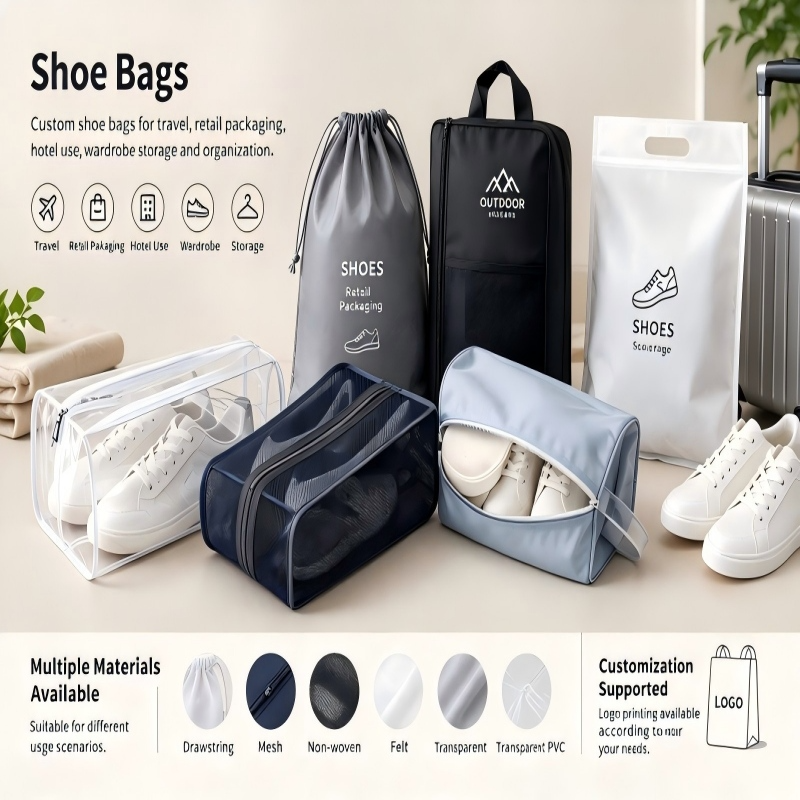
For brand owners, wholesalers, and procurement teams, key factors include logo customization, shoe compatibility, minimum order quantity (MOQ), sample quality, and delivery time. Confirming these details before ordering helps avoid sizing issues, poor packaging, and delays.
Shoe bags vary in materials, construction, and workmanship, so similar designs may not suit every purpose. Before purchasing, define the intended use, shoe type, and budget. For bulk orders, test samples with actual shoes and check the workmanship before finalizing specifications for mass production.
Why is it important to choose the right shoe bag
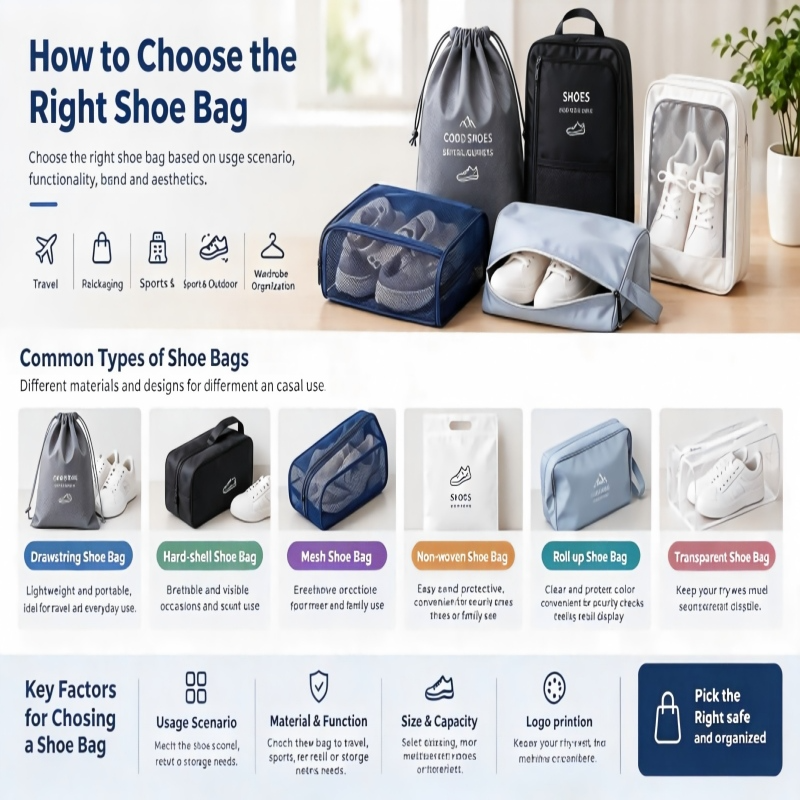
Shoe bags are not merely for storing shoes. Whether you are traveling, organizing your belongings daily, or using them for packaging and transporting shoes in a commercial setting, a suitable shoe bag keeps your shoes neatly organized and makes them more convenient to carry.
Store the shoes separately
The soles of shoes may become contaminated with dirt, dust, or stains. Storing your shoes separately in a shoe bag prevents the soles from staining your clothing or other personal belongings, while also keeping your suitcase and storage space tidier.
Facilitates classification and organization
Storing shoes separately by style or model makes it easier to quickly identify and retrieve the shoes you need. For hotels, retailers, or brand owners, different shoe bags can be used according to the shoe’s style, size, or product line. This makes it easier to distinguish between products when organizing inventory, preparing guest room supplies, or packing merchandise, while also reducing the likelihood of picking or packing the wrong item.
Provide appropriate storage protection
Different types of footwear have varying requirements for storage and protection. Since athletic shoes are worn frequently and often carried outdoors, shoe bags should ideally be sturdy and durable while also being easy to clean. For footwear that places greater emphasis on appearance—such as high heels and leather shoes—softer fabrics are more suitable; if necessary, an inner lining or separate compartments can also be added to prevent the shoes from rubbing against one another during storage and transport.
Standard shoe bags are primarily used to store footwear and separate it from other items; they cannot completely prevent water ingress or external compression. If shoes are to be transported over long distances or stored in a warehouse, further consideration should be given to the fabric’s water resistance, the bag’s structural strength, and the internal support system; the appearance and price of the shoe bag alone should not be the sole criterion.
What factors should be considered when selecting shoe bag
Before purchasing a shoe bag, first think clearly about what types of shoes you will primarily store in it, where you will use it on a daily basis, and whether you will need to carry it frequently or keep it stored for a long period. Once you have clarified these points, you can compare different fabrics, sizes, and styles; this will give you a clearer direction for your choice and make it less likely that you will end up with an unsuitable product.
Choose the appropriate shoe bag based on the material.
The material used for shoe bags directly affects their durability, breathability, portability, the visual impact of the printed logo, and overall cost.
Common materials for shoe bags include nonwoven fabric, polyester, nylon, mesh fabric, and transparent materials; each has its own characteristics and is suited to different use cases. Some are ideal for everyday storage, while others are better suited for brand packaging or occasions where shoes need to be displayed.
| Material or design | main features | applicable scene | Precautions |
| nonwoven fabric | Lightweight and suitable for a wide range of printing and packaging design applications. | Retail packaging, hotel supplies, brand promotion | The weight per unit area, durability, and sewing quality should be verified. |
| polyester | Suitable for a variety of colors, structures, and reuse requirements | Travel, athletic shoe storage, brand customization | Specific wear resistance and protective performance depend on the fabric specifications and processing method. |
| nylon | Suitable for the design of lightweight, durable products | Travel, outdoor storage, daily carry | The assessment should be conducted in conjunction with the fabric thickness, structure, and actual performance requirements. |
| mesh fabric | Promotes air circulation; certain designs facilitate viewing the contents. | Storage for athletic shoes and organization of fitness equipment | Breathability does not mean waterproofness, nor does it imply that the product has deodorizing capabilities. |
| Transparent material | Facilitates easy identification of items inside the bag and is suitable for visual display. | Retail display, categorization and organization, travel storage | The material type, thickness, durability, and required protective performance should be verified. |
If shoe bags are intended for retail packaging, in addition to price, you should also consider whether the appearance aligns with the brand image, whether the logo is clearly visible when printed, and the packaging costs associated with bulk purchases. If the shoe bags are for travel or for repeated daily use, pay particular attention to whether the fabric is durable and resistant to wear, whether they are easy to clean when dirty, and whether the zippers or drawstrings are easy to operate.
If the customer has specific requirements regarding water resistance, water repellency, or wear resistance, it is advisable to confirm the exact fabric specifications with the supplier before placing an order; if necessary, request relevant test results. Actual performance can vary across different materials, so one should not assume that a fabric will necessarily deliver the expected results merely based on its name.
Confirm the size and capacity of the shoe bag
If the shoe compartment is too small, shoes will be difficult to store; if it is too large, it will take up unnecessary space. When shopping, it is best to try on the actual shoe model first and then determine the appropriate size.
Common shoe organizers come in single-shoe, double-shoe, large-size, and multi-compartment designs. Single-shoe organizers are ideal for storing individual shoes separately or for individual packaging; double-shoe organizers are suitable for travel and everyday use; boots, high-top shoes, and oversized shoes require more space, while multi-compartment designs make it easier to organize and store multiple pairs of shoes.
When determining the correct size, measure the shoe’s length, its widest point, and its height. If the shoe is a high heel or a long boot, also consider the space occupied by the heel and the boot shaft, ensuring that the shoe fits inside and can be easily removed afterward.
For brand owners or those making wholesale purchases, it is advisable to select several representative shoe styles for fitting; do not base your selection of all specifications on a single model. Confirming the applicable shoe styles and size range in advance can help avoid issues such as insufficient capacity after mass production or inconvenient use.
Select the appropriate sealing method
Whether a shoe bag is practical and whether it is easy to open and close is also an important consideration. Drawstring designs offer convenient access and are ideal for everyday storage and simple packaging; zipper closures provide a more secure seal and are better suited for travel or situations requiring repeated opening and closing. For brand owners, when choosing a closure method, they should also take into account the product’s appearance, frequency of use, and overall cost, avoiding the tendency to focus solely on aesthetic design while neglecting the actual user experience.
| Sealing method | merit | applicable scene |
| drawstring | Easy to open and close, with a relatively simple structure. | Daily organization, travel shoe bags, promotional packaging |
| zipper | Makes it easier to seal the bag opening, making retrieval and placement more intuitive. | Reusable shoe bags, travel organizers, and branded customization |
| Other Custom Structures | The appearance and mode of use can be adjusted according to design requirements. | Development of specific packaging items or differentiated products |
When choosing a shoe bag, in addition to considering the type of closure, you should also test whether the shoes can be easily placed inside and removed. If the opening is too narrow, the shoes may get stuck when stored; if the zipper is difficult to pull or the drawstring is not easy to operate, using the bag will also be cumbersome. Therefore, both the size of the opening and the closure method should be chosen in consideration of the shoe’s dimensions.
If the shoe bag will be used repeatedly over an extended period, it is worth paying attention to whether the zipper glides smoothly, whether the drawstring is sturdy, whether the drawcord buckle is secure, and whether the stitching around the opening is robust. For bulk purchase orders, it is advisable to first inspect a sample and then conduct actual opening and closing tests, thereby avoiding the discovery of these details as problematic only after the product has been put into service.
Select based on protection and cleaning requirements
Different shoe bag materials offer different performance characteristics. For everyday storage of athletic shoes, breathable mesh fabric is a good choice; for dust protection, non-woven fabric or polyesterter is recommended; and if you are concerned about water stains, make sure that the material has been treated with water resistance technology.
Leather shoes and high heels are prone to scratches; it is therefore advisable to choose shoes made from soft, supple materials or models with a lining to reduce friction between the shoes. If the shoe bag will be used frequently, also consider whether it is easy to clean and whether the bag will deform or fade after washing.
When procuring, do not rely solely on product descriptions. First, determine the actual intended use of the shoe bag; then, inspect the fabric, stitching, and performance using a sample. It is also important to note that breathability does not equate to moisture resistance, and water resistance does not mean complete waterproofing; it is best to confirm the specific performance requirements with the supplier in advance.
Consider whether it is convenient to carry and whether it takes up space when stored away
If shoe bags are primarily used for travel, it is best to choose a lightweight model made of soft fabric and designed for easy folding. When not in use, they can simply be stored in a suitcase or backpack, so they do not take up much space. If you need to carry them frequently or if staff will need to repeatedly retrieve and return the shoe bags, a handle design will be more convenient—especially in hotel amenity settings and for travel organization.
For brand owners and wholesale buyers, it is also important to consider the volume of shoe bags during packaging and transportation. Soft, foldable shoe bags are generally easier to organize and pack, but the amount of space they can actually save depends on the fabric thickness, bag structure, and dimensions after folding. Before placing a bulk order, you can ask the supplier to provide a physical packaging sample to confirm the load capacity per case and the dimensions of the outer carton, thereby facilitating the subsequent arrangement of warehousing, transportation, and logistics costs.
How should you choose the right shoe bag for different use cases
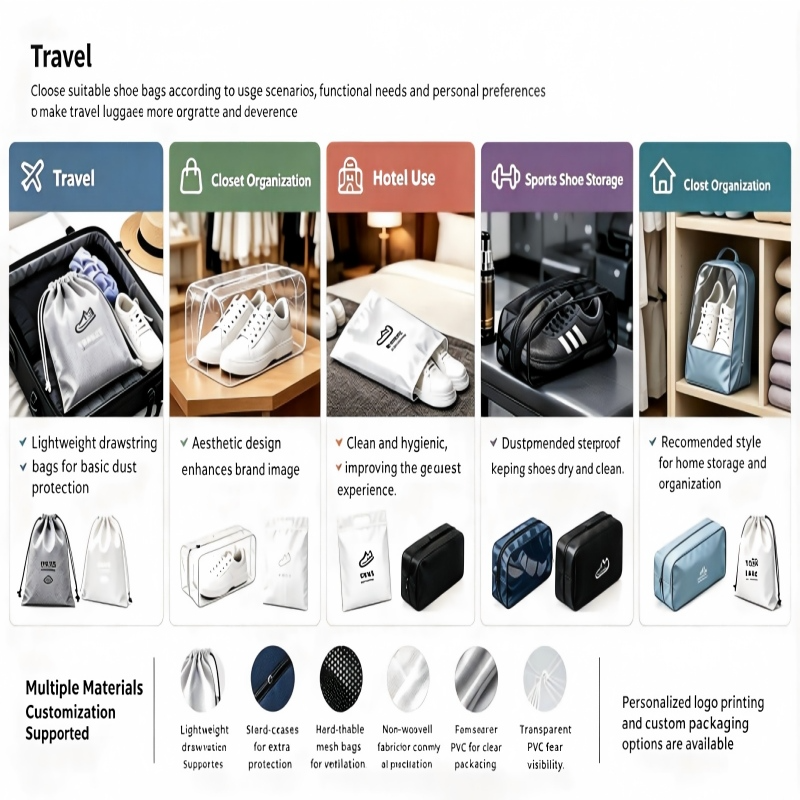
The intended use of a shoe bag determines the type of material and design it requires. Clarifying its purpose before procurement will make it easier to determine the appropriate dimensions and costs later.
For travel and outdoor use
When traveling, a shoe compartment keeps your shoes separate from your clothing, preventing the soles from dirtying your luggage. For short trips, opt for lightweight models that are easy to fold; when you need to carry multiple pairs of shoes, pay attention to capacity and the number of compartments. Since outdoor use often exposes items to mud and water, it is best to choose a material that is durable and easy to clean.
Retail Packaging and Brand Promotion
When customizing shoe bags for a brand, it is important not only to consider whether there is enough capacity, but also whether the appearance aligns with the brand’s style. The fabric, color, dimensions, and logo should all be confirmed in advance, and the cost of individual packaging should also be taken into account. Nonwoven fabric is suitable for lightweight packaging needs, while polyester can be used for styles intended for repeated use; the specific choice ultimately depends on the product positioning and budget.
Hotel amenities
When procuring shoe bags for a hotel, consider whether they will be convenient for guests to use and whether they will need to be cleaned and reused afterward. For single-use designs, focus more on material and packaging costs; for reusable designs, prioritize greater durability. Before placing a bulk order, also confirm the dimensions, labeling, packaging quantity, and delivery schedule.
Shoe Storage and Wardrobe Organization
Since athletic shoes are worn frequently and stored often, it is best to choose a shoe bag that is durable and also allows for good breathability. When storing shoes in a wardrobe, you can choose a single-item compartment, a pair-of-shoes compartment, or a model with multiple compartments based on the number of shoes you have. If you have a large collection, adding a transparent window or labels will make locating your shoes much easier.
Storage for Specialized Footwear
High heels, tall boots, and platform sneakers have different shapes, so standard shoe bags may not provide adequate space. When storing tall boots, pay attention to the height of the bag; for high heels, consider the space available for the heel; and for high-top shoes and size-extended footwear, a larger bag interior is necessary. For delicate styles that are prone to scratches, opt for soft fabrics or designs with internal compartments.
For bulk purchases, it is best to try on the actual shoe models. Confirm that the shoes fit properly and that they are easy to put on and take off; then determine the size and fit, which will reduce the need for subsequent rework.
How to customize shoe bags tailored to your business needs
If shoe bags are used for brand packaging, hotel amenities, or corporate gifts, companies can customize the size, fabric, color, and logo based on the intended use, ensuring that the product better aligns with their specific needs.
Confirm the material, dimensions, and structure
Before customizing shoe bags, first determine which types of shoes will be stored, how many pairs will be placed in each bag at a time, and how the bags will be used in everyday situations; then discuss the specific specifications with the supplier. When communicating, it is advisable to prepare the following information in advance:
- Shoe size: Provide the length, width, and height of the shoes to avoid using a bag that is too small to fit them.
- Fabric requirements: specify the material, thickness or weight per unit area, and whether properties such as water repellency or wear resistance are required
- Bag specifications: Confirm the length, width, and height, as well as the measurement method for dimensions
- Structural design: Select drawstrings, zippers, handles, or internal compartments as needed
- Appearance requirements: Provide specifications for color, transparency, logo design, and printing requirements
If all the details have not yet been finalized, there is no need to rush into specifying the requirements. You can first send the desired shoe size, intended use case, and reference images to the supplier, and then discuss a suitable solution based on the actual circumstances.
Confirm logo printing and brand design
When customizing shoe bags, in addition to providing the logo file, you should also confirm in advance where the printing will be placed, the size of the print, the color to be used, and the printing method. Printing results can vary depending on the fabric; it is therefore advisable to create a sample first to verify that the actual result meets the brand’s requirements.
When confirming the sample, focus on checking whether the logo is clear and whether its position and color are correct, as well as whether the printed areas may be affected by zippers or stitching. Once the sample has been confirmed, it is recommended that the final design file and the sample be retained as references for mass production, thereby minimizingg deviations during large-scale production.
Confirm the minimum order quantity, price, and delivery lead time
The price of custom shoe bags is influenced by factors such as the material, dimensions, logo printing, and order quantity. When requesting a quote, in addition to confirming the minimum order quantity and unit price, you should also clarify the sample fee, customization fees, production lead time, and packaging requirements.
If you need to place a follow-up order, you can also learn in advance about the requirements for placing such an order and the expected lead time. When purchasing in bulk, you should not focus solely on price; sample quality, consistency with the final production batch, and on-time delivery are equally important. All costs, quantities, and delivery schedules should be based on the supplier’s formal quotation and the order requirements mutually confirmed by both parties. Clarifying these details in advance will make subsequent cooperation smoother.
Shoe Bag Dimensions and Sample Confirmation: Practical Inspection Checklist Before Procurement
For customized and bulk procurement projects, confirming dimensions and samples is a critical step in minimizing subsequent rework. Relying solely on product photographs or reference dimensions makes it difficult to determine whether a shoe bag truly fits. For customized and bulk purchases, it is best to try the actual footwear on before finalizing the specifications.
Measure your shoe size accurately
Measure the length, widest point, and height of the shoes, and determine whether you need to store them individually or as a pair. If you plan to store multiple pairs, also consider the overall available space once the shoes are arranged.
Determine the size and style of the shoe bag
Determine the bag’s overall dimensions and opening size based on the shoe’s size and how it will be placed. For zipped models, ensure that the shoe can be easily placed inside and removed; for drawstring models, make sure that the opening can be tightened smoothly. A reasonable allowance should also be built into the dimensions; they should not be manufactured solely based on the shoe’s length and width.
First, inspect the sample
Before placing your order, it is advisable to try on the actual shoe model to assess whether it is easy to put on and take off, and to inspect the fabric, stitching, zipper, handles, and the quality of the logo printing. If you have specific requirements for water repellency or wear resistance, these should also be tested in advance.
Confirm the main shipment specifications
Once the sample has been confirmed, clearly specify the dimensions, materials, color, printing artwork, packaging method, and quality requirements; these will serve as the basis for mass production. If the order includes multiple dimensions or colors, each should be verified separately to prevent specification confusion or printing errors in the final batch.
Frequently Asked Questions
What material is best for shoe bags?
There is no single optimal material suitable for every scenario. Nonwoven fabrics suit a wide range of packaging needs; polyester and nylon can be used for different types of travel and reusable shoe bags; mesh materials promote air circulation, while transparent materials make it easier to identify the contents. Ultimately, the choice should be based on durability, appearance, frequency of use, and budget.
What size shoe compartment should you choose?
The dimensions should be determined based on the length, width, and height of the target footwear model, as well as its placement method and the available packaging space. Size requirements may differ for ordinary athletic shoes, platform shoes, long boots, and high heels. When preparing for bulk packaging, the applicable range of footwear models should first be identified and verified using physical samples.
Are mesh shoe bags waterproof or deodorizing?
These functions should not be assumed to be inherently present. A mesh structure facilitates air circulation, but it generally cannot provide complete waterproof protection nor serve as a substitute for cleaning and drying treatments. Where explicit requirements for waterproofing or odor control are specified, the materials, structure, and relevant performance criteria should be verified separately.
Can the shoe bag have a custom logo?
Depending on the specific product and the processing capabilities of the supplier, you can evaluate logo printing and other brand customization options. Before formal production begins, confirm the printing files, colors, placement, and process, and verify the actual results through sample inspection.
When placing a bulk order for shoe bags, what information should be prepared in advance?
It is recommended that you prepare the intended use, shoe size, material requirements, closure structure, color, logo files, estimated order quantity, packaging requirements, and delivery lead time. The more specific the information provided, the more conducive it will be for suppliers to conduct specification evaluation, prepare quotations, and develop samples.
How do I begin customizing or purchasing shoe bags
When selecting a shoe bag, first consider its intended use and budget, then take into account the dimensions, fabric, and closure design. For brand owners, retailers, and hotel procurement staff, it is also advisable to confirm in advance the logo customization, minimum order quantity, sample quality, and delivery lead time, so that you do not discover after placing the order that the product does not meet your requirements.
Before contacting a shoe bag supplier, you can prepare several pieces of basic information in advance:
- Use cases: travel organization, retail packaging, hotel amenities, or sports shoe storage
- Product specifications: shoe size, storage capacity, and bag style
- Material requirements: non-woven fabric, polyester, nylon, mesh fabric, etc.
- Customization requirements: color, logo, zipper, drawstring, and other accessories
- Procurement Plan: Estimated quantity, budget, sample requirements, and lead time
If you have not yet decided on the specific specifications, you can first inform the supplier of what type of footwear you intend to install and where it will primarily be used; then, discuss the dimensions and materials based on the actual circumstances. Before mass production, it is advisable to first confirm the sample, verify that installation and removal are convenient and that the workmanship meets the required standards, and finalize the final specifications and quality standards; this will provide a clearer basis for subsequent production and acceptance inspection.