
In modern household living, under-bed storage boxes have gradually become practical storage solutions for maximizing space utilization. Whether in small apartments or in homes with more spacious living areas, making effective use of the space beneath the bed can provide greater convenience for organizing the bedroom.
The space beneath the bed typically occupies a considerable portion of a bedroom; however, because it is out of sight and rarely accessed in daily life, it often becomes an overlooked storage area. Many households simply pile old clothing, cardboard boxes, shoe boxes, or miscellaneous items beneath the bed; while this may provide additional storage space in the short term, it can easily lead to problems such as dust accumulation, disorderly items, and difficulty accessing stored belongings over time.
Properly organizing the space beneath the bed not only frees up bedroom space but also provides better protection for clothing, bedding, and seasonal items. Selecting the right under-bed storage box can further enhance organization efficiency, allowing hidden storage space to truly serve its purpose.
This article will guide you through how to create a more efficient under-bed storage solution, covering topics such as under-bed organization methods, the selection of storage accessories, space planning, and long-term maintenance.
Why Under-Bed Space Warrants Full Utilization
Within limited living spaces, how to improve bedroom storage efficiency has become a concern for many households. When planning their space, many people typically prioritize wardrobes, storage cabinets, and shelving units, while often overlooking the bed base—an area that offers a relatively large hidden storage space.
In fact, under-bed storage offers the advantages of occupying a relatively large floor area, having a fixed location, and not interfering with daily activities, making it highly suitable as a long-term storage area. Making effective use of under-bed space not only frees up room in other areas of the bedroom but also helps keep the room tidy and organized.
This is especially true for small-apartment households or those living in spaces with limited bedroom area, where under-bed storage can effectively hold seasonal clothing, spare bedding and quilts, travel essentials, and items that are temporarily not in use. Rather than purchasing additional large storage furniture, using under-bed storage boxes not only reduces storage costs but also makes the overall bedroom layout cleaner and more aesthetically pleasing.
However, efficient under-bed storage does not simply involve stuffing all items into available space; rather, it requires thoughtful planning based on the type of items, how frequently they are used, and the specific storage needs. Selecting the right under-bed storage solutions—such as dust-proof storage bags, foldable storage boxes, or zippered storage boxes—can better protect clothing and household items and prevent damage caused by dust, moisture, and prolonged storage.
Through scientific categorization and thoughtful organization, the space beneath the bed can be transformed from an easily overlooked corner into a practical and efficient bedroom storage area, maximizing the value of limited space.
Assess Your Under-Bed Storage Needs
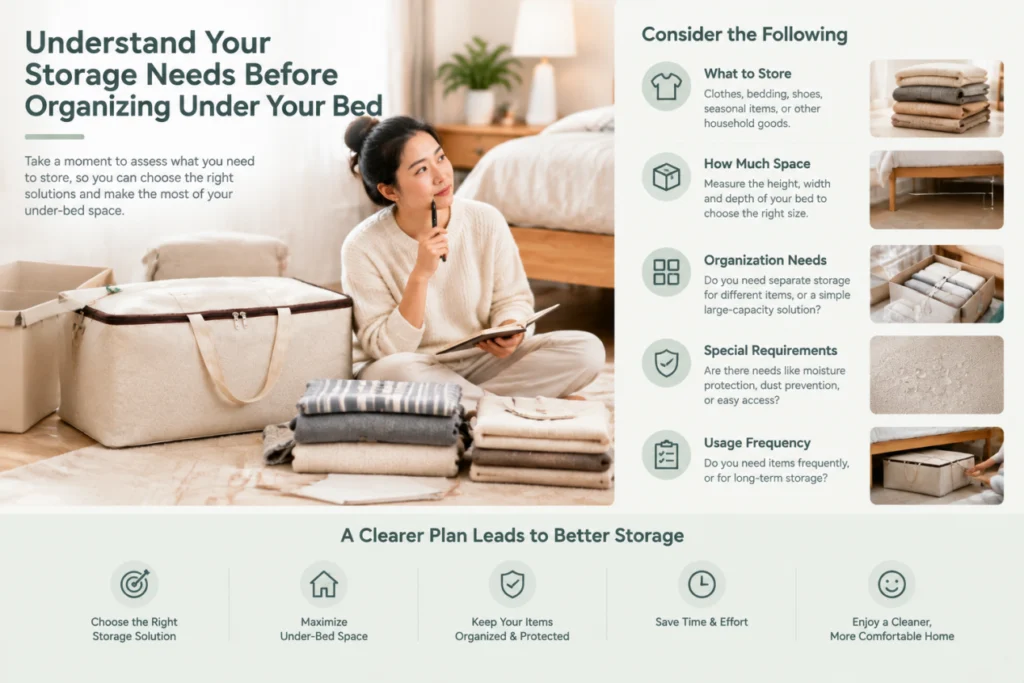
Before formally beginning under-bed storage, the first step is not to purchase storage tools; rather, it is to completely clear the space beneath the bed and reorganize and categorize the items already there.
Many households experience insufficient storage space not solely because of limited room area, but because their belongings have not been sorted or thoughtfully organized over an extended period. For example, items that have gone unused for years, damaged household goods, and repeatedly purchased items often occupy a significant amount of under-bed storage space, thereby reducing overall storage efficiency.
Through organization and categorization, it becomes clear which items are worth keeping and which need to be disposed of; it also enables a more accurate determination of the capacity and type of under-bed storage box required for future purchases.
During the classification process, items can be categorized based on their frequency of use and storage requirements:
| Item Type | Recommended handling method |
| Frequently used items | Place it in a convenient location for easy access, avoiding the need to move other items each time you need to use it, thereby improving daily efficiency. |
| Seasonal items | Store items such as seasonal clothing and bedding in a sealed under-bed storage box that is dustproof and moisture-resistant, thereby minimizing the impact of dust and humidity on the items. |
| Long-term idle items | Reassess whether items still have value for retention; promptly clear out items that are no longer in use to avoid occupying limited storage space. |
Once the items have been sorted, you can select a bed base storage box of the appropriate size based on the quantity, dimensions, and frequency of use of the remaining items. A well-designed capacity not only makes full use of the space beneath the bed but also prevents the storage box from becoming overfilled, which would make items difficult to access; this keeps bedroom organization cleaner and more efficient.
Measuring the space beneath the bed is an important step in selecting a storage solution
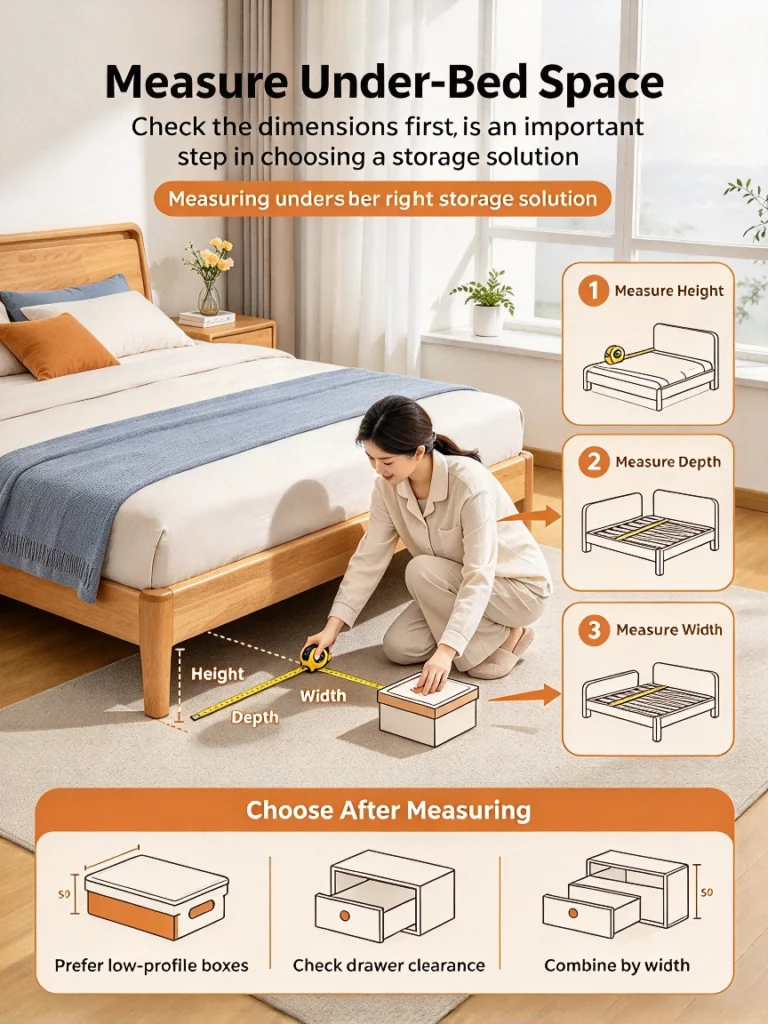
Many people overlook the issue of size compatibility when purchasing under-bed storage containers.
A larger storage compartment beneath the bed does not necessarily mean a better solution. If the storage compartment is taller than the available space beneath the bed, items may not fit inside, and the stability of the bed may also be compromised; if the compartment is too small, storage space will be wasted.
Before selecting a bed base storage box, you should measure in advance: the height of the bed base, the available length, the available width, the bed legs, and the bed frame structure.
There are differences among various bed types; for example, standard bed frames, box-type beds, and beds with drawer designs have different requirements for storage solutions.
Once the dimensions have been confirmed, you can choose several small-capacity storage boxes based on your actual space, or opt for a single large-capacity storage bag.
For households that need to store clothing and bedding for extended periods, large-capacity zippered storage boxes are generally more convenient, as they help prevent dust from entering while making the entire unit easier to move.
How do you choose the right under-bed storage box?
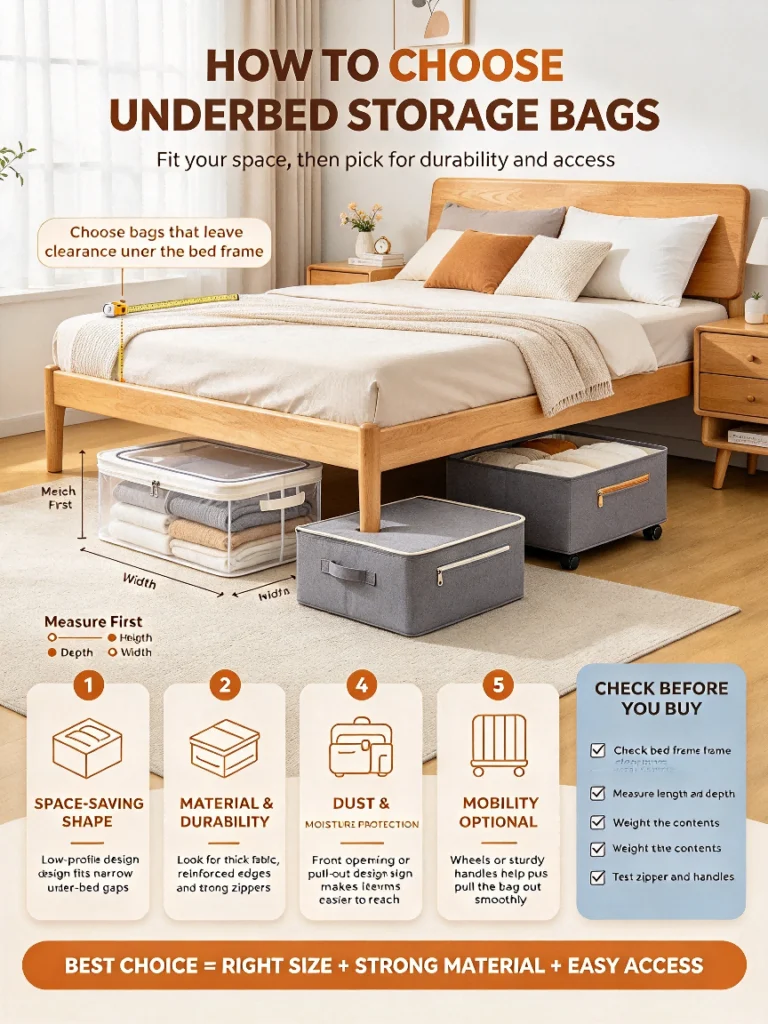
The materials and construction of the under-bed storage compartment directly affect its service life and the overall organization experience.
Different households have different needs: for example, short-term organization may place greater emphasis on price and capacity, whereas long-term storage places greater emphasis on durability, dust resistance, and ease of use.
The characteristics of common materials are as follows:
| material quality | characteristic | Suitable scenarios |
| non-woven fabrics | Lightweight and reasonably priced, making it suitable for most household storage needs. | Clothing, bedding, and seasonal items |
| polyester fibre | It offers good wear resistance and is suitable for long-term repeated use. | High-frequency retrieval and mobile storage |
| cotton cloth | Natural feel and strong eco-friendliness | High-Quality Home Storage |
In addition to the materials, structural design is equally important.
For example, a zippered storage compartment beneath the bed provides better sealing, reducing the amount of dust that enters; a transparent viewing window allows users to quickly identify the items inside, eliminating the need to open it repeatedly; and the addition of a carrying handle makes it easier to move the unit when tidying the room, moving house, or changing seasons.
Therefore, when choosing a bed base storage box, you should not focus solely on appearance and price; instead, you should make your decision based on the actual frequency of use.
How should different items be stored beneath the bed?
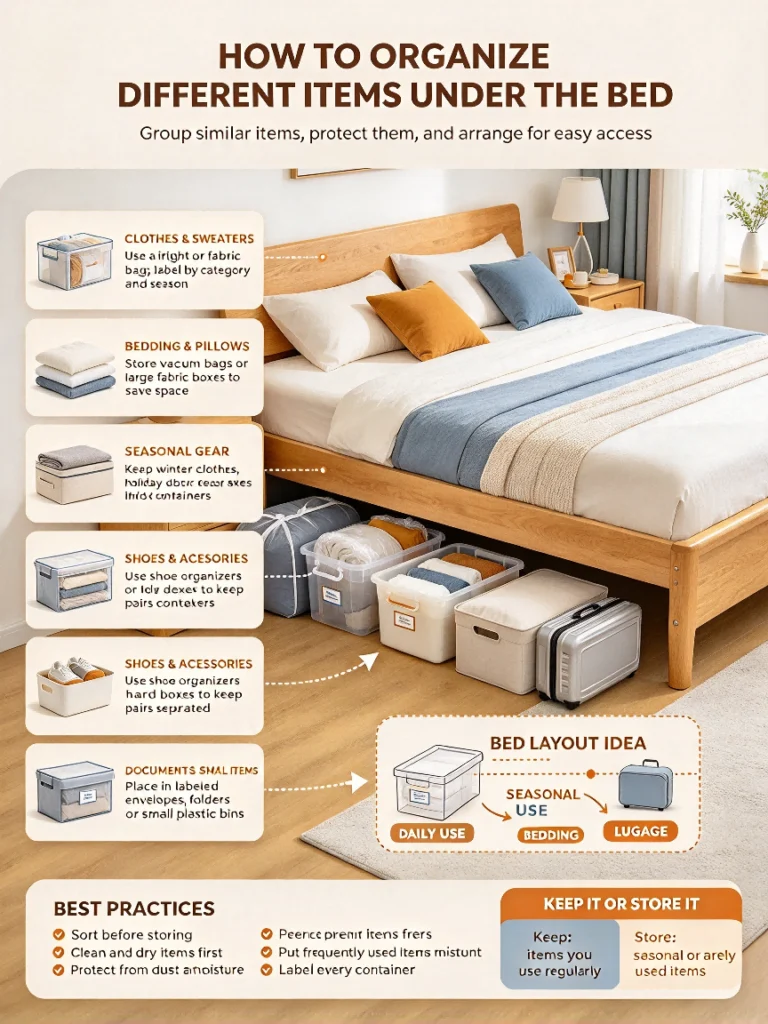
The most important aspect of under-bed storage is proper categorization. If all items are placed together, even if there is sufficient space, the efficiency of future use will be reduced.
For clothing items, it is recommended that they be categorized according to the season. For example, thick winter garments can be stored together, while summer clothing can be organized separately; for bedding items such as quilts, blankets, and spare sheets, which are used less frequently, they are ideally placed in the space beneath the bed; for footwear and travel accessories, it is advisable to use dedicated bags for separate organization to avoid mixing them with clothing items.
With proper planning, each storage box will have a clearly defined purpose, making it more convenient to locate items in the future.
How can you improve the efficiency of under-bed storage?
Effective storage not only increases capacity; more importantly, it improves usability.
First, avoid overfilling storage boxes. To maximize space utilization, many people pack their boxes to the brim; this not only impairs the function of the zippers but may also cause the box to deform. Second, try to maintain clear categorization. If multiple storage boxes are placed under the bed, they can be organized using color coding, labels, or transparent viewing windows. For example:
| Storage area | Recommended storage content |
| Anterior lower part of the bed | Items that are frequently needed |
| Center of the bed base | Seasonal clothing and bedding |
| A relatively deep position beneath the bed | Long-term storage supplies |
This approach to planning can reduce the time spent on daily tidying and make under-bed storage more efficient.
frequently asked questions
Why is it not recommended to store items directly in cardboard boxes?
Cardboard boxes are prone to absorbing moisture and accumulating dust; with prolonged use, they may also warp or become damaged. In contrast, storage bags for under-bed use are made from more durable materials, and some designs even support foldable storage, making them more suitable for long-term storage of clothing and bedding.
Why should dust protection be taken into account when storing items beneath the bed?
The base of the bed is close to the floor, making it prone to accumulating dust. It is recommended to use a bed-base storage bag with a zipper or dust cover to prevent dust from entering and keep your belongings clean.
Why should you measure the dimensions before purchasing a bed base storage bag?
Different bed types have different base heights and available storage space. Measuring the length, width, and height in advance can prevent the storage bag from being too large to fit, or from being too small and resulting in wasted space.
Why should under-bed storage be organized by category?
Storing seasonal clothing, bedding, and travel essentials in separate compartments can reduce the time spent searching for items and keep the space beneath the bed tidy.
When choosing a bed-bottom storage bag, why shouldn’t you consider capacity alone?
In addition to capacity, you should also consider the fabric, zipper, handle, and dust resistance. Selecting the appropriate structure based on the items stored and the frequency of use will ensure a balance between practicality and durability.
How can you keep the space beneath the bed tidy over the long term?
Once the organization is complete, long-term maintenance is just as important. It is recommended that you regularly inspect the items stored beneath the bed and adjust the contents based on seasonal changes.
For example, before winter arrives, you can start taking out your heavy clothing in advance while organizing your summer supplies. In addition, the area beneath the bed should be cleaned regularly to prevent dust from accumulating over time. Good storage habits ensure that the space beneath the bed continues to serve its purpose, rather than once again becoming a place for clutter to pile up.
Make the space beneath the bed a key area for home organization.
The space beneath the bed is not a wasted area; rather, it is a crucial component of the home storage system.
Through proper categorization, thoughtful dimension planning, and the selection of a suitable under-bed storage box, you can effectively maximize the utilization of bedroom space, keeping your clothing, bedding, and household items neat and organized.
For household users, a scientific approach to under-bed organization can enhance daily convenience; for home furnishing brands and procurement companies, developing storage box products that meet consumer needs can also satisfy the ever-growing demand for space organization.
A good storage solution does more than simply conceal items; it makes your living space more efficient and comfortable.